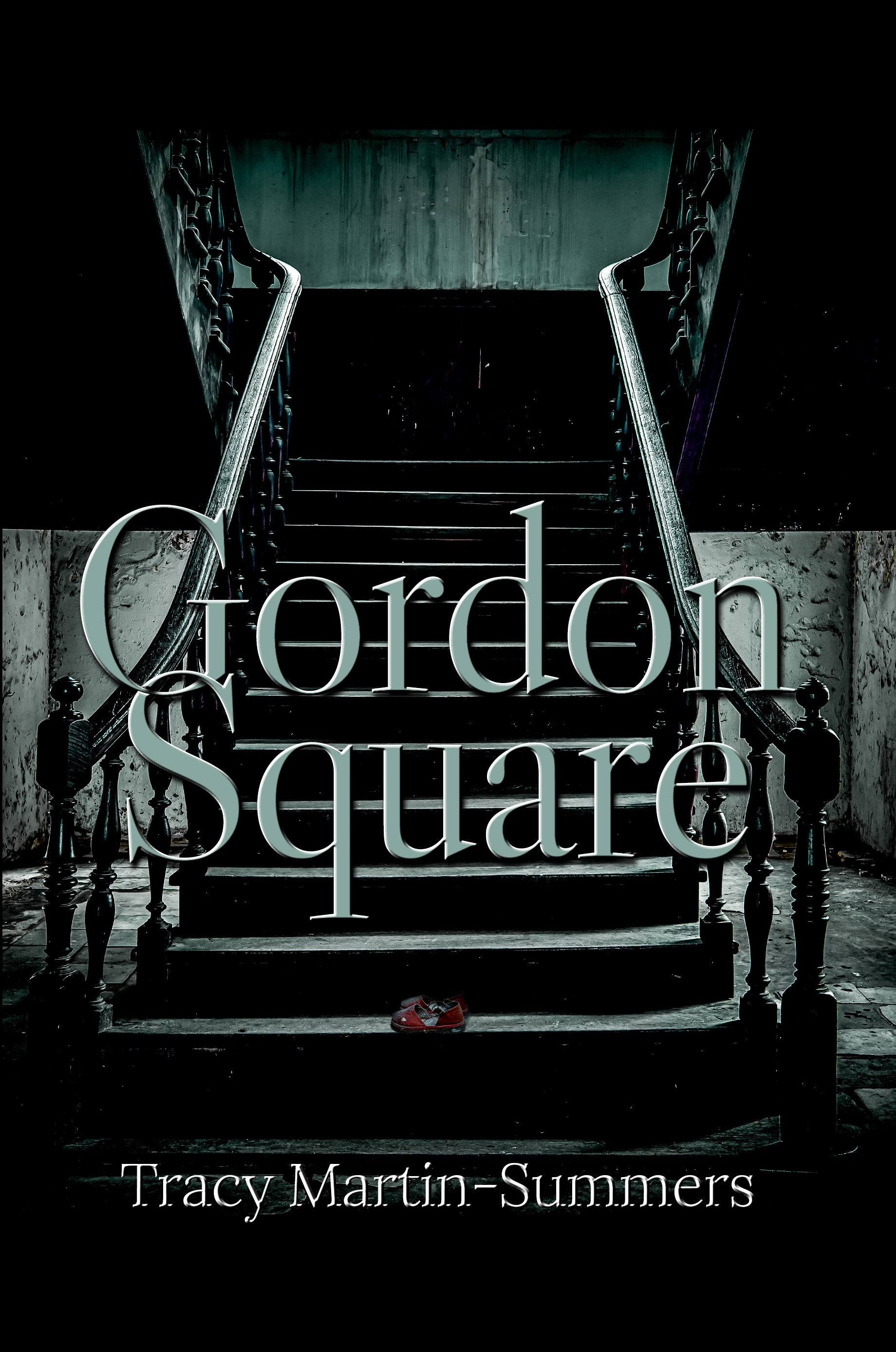
On a cold blustery November night, Detective Sergeant Mike Brugge and his partner Detective Constable Mel Bailey come across a girl, age unknown, in the parkland in Gordon Square. She was frail, malnourished, dirty and covered in excrement.
What had happened to this girl? Why was she covering down, shielding her eyes from the light, with a look of horror on her face? She appeared to be non-coherent, totally unengaged and would not speak to anyone. Nothing could penetrate the world where her soul had taken solace.
Mike and Mel set out to find out where she had come from and what had been per plight. Revealing hypnosis sessions allow them to glimpse some of her pain suffering. Follow their story deep into the horrors that unfold, causing chaos and turmoil among their own lives.
The detectives are about to discover a horrific, gut-wrenching story, that spanned over four decades. But will it end?
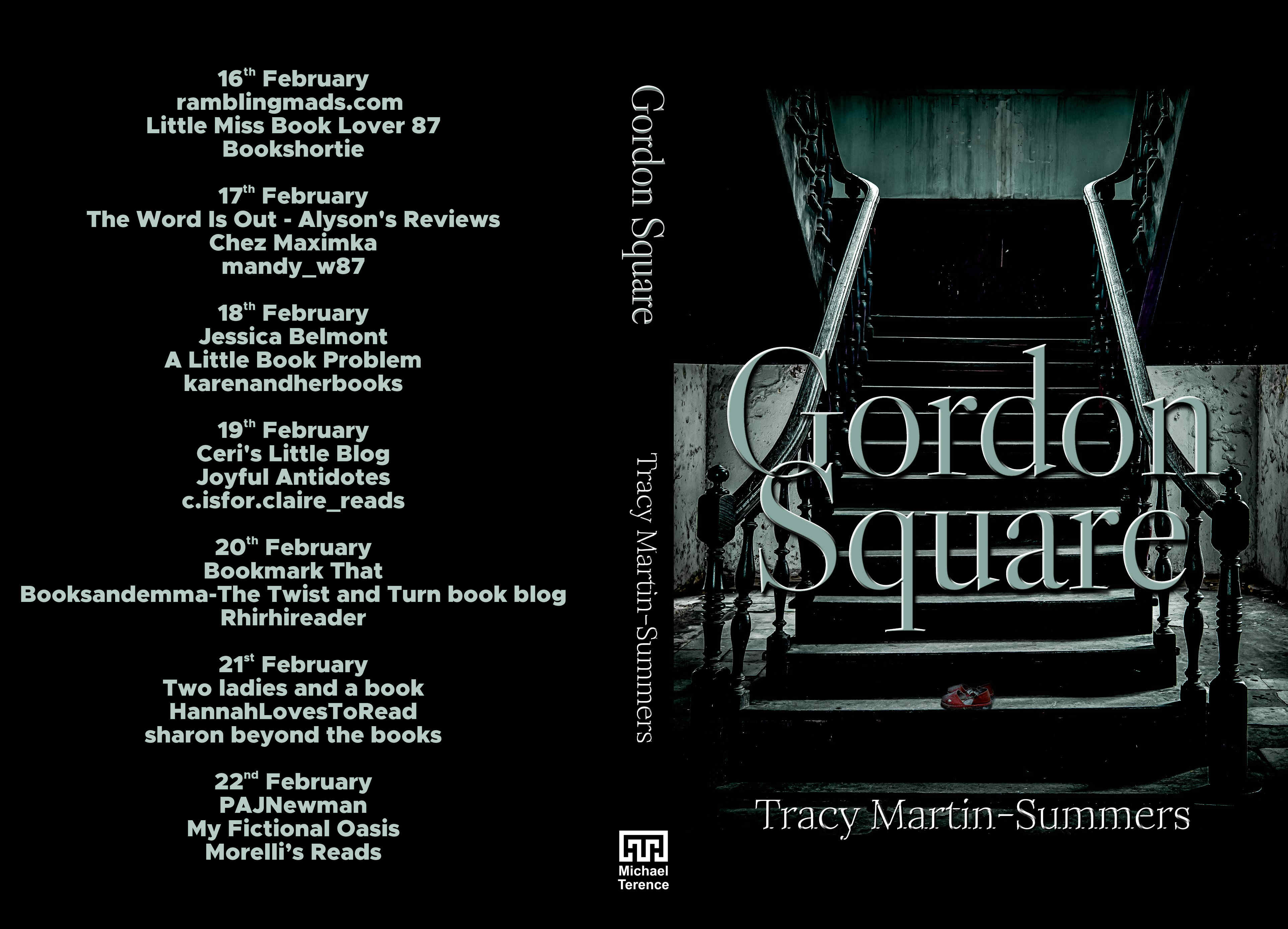
Secrets, lies and the dark side of humanity abound in Tracey Martin-Summers’ debut crime novel, ‘Gordon Square’.
The location of Gordon Square is never explicitly geographically placed, but Martin-Summers’ plot driven, atmospheric writing allows the reader to be swept along into the dark lands of the worst of human nature.
This is a dark and terrifying world where traumatised people are often at the mercy of their own worst instincts and misery is handed on, generation to generation. It has the unhappy ring of verisimilitude to it as well, which is sad.
Martin-Summers’ style is one of dialogue-driven plot propulsion using the characters to examine the impact of cruelty and prolonged suffering on people and the evil that we do to each other.
A punchy, well-crafted crime story heavy on atmospherics and the dark heart of human nature at its worst, alleviated by the power of love – especially between friends – which raises a potentially grim milieu to be a satisfying read.
Debut author Tracey Martin-Summers
Author Bio – Tracy was born in Harrow Weald, Middlesex in 1964, growing up in a loving family home. She married her first husband in 1990, has two grown up children and a granddaughter.
She studied a variety of topics via module learning, embarking on City and Guilds and NVQ courses, ranging from a brief spell in hairdressing to administration and now works for a utility company in North West London.
Tracy has numerous hobbies consisting of landscape painting to landscape gardening and always likes to paint the scene, even if it’s changing the colour scheme, yet again, within her home.
Tracy has always enjoyed writing and used to write short stories for her own children’s amusement but it has only been in the last few years that she has taken this more seriously and has gone on to write her debut crime detective novel, ‘Gordon Square’.
Tracy Married her second husband in 2014 and now lives in Bedfordshire in a sleepy hamlet where she writes whenever she gets a spare moment.
When a body turned up at her last catering gig it certainly put people off the hor d’oeuvres. So with a reputation to salvage, Jodie’s determined that her next job for the village’s festival will go without a hitch.
But when chaos breaks out, Jodie Parker somehow always finds herself in the picture.
The body of a writer from the festival is discovered at the bottom of a cliff, and the prime suspect is the guest of honour, the esteemed painter Duncan Stovall. With her background in the Met police, Jodie has got solving cases down to a fine art and she knows things are rarely as they seem.
Can she find the killer before the village faces another brush with death?
The second book in the Jodie ‘Nosey’ Parker cosy mystery series. Can be read as a standalone. A humorous cosy mystery with a British female sleuth in a small village. Includes one of Jodie’s Tried and Tested Recipes! Written in British English. Mild profanity and peril.
‘A Brush with Death’ picks up fully where the opening installment left off. Having left the Met, Jodie ‘Nosey’ Parker is still down in Cornwall and trouble is never far away.
Leitch is a charming observer of small town mores, in fact the opening line: “Whatever you do, don’t call it a fete,” is the sort of thing which people who have lived in small villages where appearances matter, will certainly recognize.
As Parker goes about trying to find out who has bumped off the guest of honour at the definitely NOT a fete, Leitch reintroduces us to the light hearted ways of her catering detective, this time in a narrative sprinkled with even more pop culture references spanning the decades (“Terminator… Abigail’s Party”)
In lockdown, many people appear to have returned to Agatha Christie or the cozy crime genre to take advantage of escapism in its purest form. Leitch is becoming one of the best at taking the minutiae of village life so beloved of the Golden Age legends and putting a humerous modern spin on it.
Author Bio – Fiona Leitch is a writer with a chequered past. She’s written for football and motoring magazines, DJ’ed at illegal raves and is a stalwart of the low budget TV commercial, even appearing as the Australasian face of a cleaning product called ‘Sod Off’. Her debut novel ‘Dead in Venice’ was published by Audible in 2018 as one of their Crime Grant finalists. After living in London, Hastings and Cornwall she’s finally settled in sunny New Zealand, where she enjoys scaring her cats by trying out dialogue on them. She spends her days dreaming of retiring to a crumbling Venetian palazzo, walking on the windswept beaches of West Auckland, and writing funny, flawed but awesome female characters.
The cover of ‘The Invisible Case’ by Isabella Muir
‘The Invisible Case’ by Isabella Muir
Narrator: Bridget Eaton
Heartbreaking tragedy or cold-blooded murder…?
An Italian stranger arrives in Tamarisk Bay and brings with him mystery and intrigue….
It’s Easter 1970 in the seaside town of Tamarisk Bay. Amateur sleuth and professional librarian, Janie Juke, is settling into motherhood and some quality time with her family. When her Aunt Jessica is due back from Rome after nine years travelling around Europe, she arrives back in town with a new Italian friend, Luigi, and the whole family soon get embroiled in a tangle of mystery and suspicion, with death and passion at the heart of the story.
As time runs out on Luigi as prime suspect for murder, Janie has to use all of her powers of deduction in the footsteps of her hero, Hercule Poirot, to uncover the facts. Why did Luigi come to Tamarisk Bay? What is the truth about his family?
As Luigi’s story unfolds, tragedy seems to haunt the past, present and unless Janie acts fast, possibly what is yet to come.
If you love Agatha Christie style twists and turns, or are a fan of Call the Midwife, Endeavour, Inspector George Gently and all those great 60s characters, then you will love this Sussex Crime series.
The third of Isabella Muir’s Janie Juke mysteries is ‘The Invisible Case’. Set in the fictional Sussex seaside town of Tamarisk Bay, this novel begins with the return from Italy of Janie’s aunt, Jessica, with her young Italian travelling companion, Luigi.
Janie Juke is a charming protagonist. A part time librarian and full time busy body, Janie is building up a reputation in Tamarisk Bay as the go-to person when people need a little help.
Ably supported by her lovely young husban1d, her blind father and, this time, her aunt, Janie has a supportive home environment for sniffing out clues and plenty of time to indulge her hero worship of Hercule Poirot.
So far so good. For me, however, the biggest plus of the novel is Jessica. The free spirited aunty who helped raise Janie, her return from nearly a decade travelling offers another element to the story and is a live wire character who Janie can investigate alongside and spark off.
The biggest negative of the novel is Luigi. Whilst it is always interesting to have an unsympathetic character, Luigi is such a whiny, despicable man/child that you not only don’t care if Janie clears his name, you absolutely long for her to have him go to the gallows – abolition of hanging not withstanding.
‘The Invisible Case’ is a quick read, cheerful in aspect and faithful to its cosy crime heritage and wearing its love for Agatha Christie and Golden Age of crime fiction lightly.
Isabella is never happier than when she is immersing herself in the sights, sounds and experiences of the 1960s. Researching all aspects of family life back then formed the perfect launch pad for her works of fiction. Isabella rediscovered her love of writing fiction during two happy years working on and completing her MA in Professional Writing and since then has gone to publish five novels, two novellas and a short story collection.
The Invisible Case is the third book in her Sussex Crime Mystery series, featuring young librarian and amateur sleuth, Janie Juke. Set in the late 1960s, in the fictional seaside town of Tamarisk Bay, we meet Janie, who looks after the mobile library. She is an avid lover of Agatha Christie stories – in particular Hercule Poirot – using all she has learned from the Queen of Crime to help solve crimes and mysteries. All three novels are now available as audiobooks.
As well as three novels, there are three novellas in the series, which explore some of the back story to the Tamarisk Bay characters.
Her latest novel, Crossing the Line, is the first of a new series of Sussex Crimes, featuring retired Italian detective, Giuseppe Bianchi who arrives in the quiet seaside town of Bexhill-on-Sea, East Sussex, to find a dead body on the beach and so the story begins…
Isabella’s standalone novel, The Forgotten Children, deals with the emotive subject of the child migrants who were sent to Australia – again focusing on family life in the 1960s, when the child migrant policy was still in force.
Moneymakers are king, no matter their methods. When an honest man stumbles into their world of deceit, will they drag him down to destruction?
London, 1986. Rupert Brett is eager to make his mark. But even though he’s newly qualified to tackle jobs within the cutthroat property brokering industry, his ambitions are blunted when he must face off against ruthless competitors. And with his career on the line, he finds himself adrift in the murky waters of insider trading where knowledge is the real currency.
Clinging to his ideals but beginning to realize how deep the corruption goes, Rupert’s unprepared when a group of hard-nosed developers frame him for murder. With few friends and the law on his tail, his only way out may be a bargain with the devil.
Can the young surveyor thwart his enemies’ plans in time to save his reputation and his life?
‘A Deadly Deal’ is the immersive first book in the Deal Series of historical crime thrillers. If you like conflicted characters, rich period details, and complex plotting, then you’ll love Simon Fairfax’s gritty page-turner.
‘
The cover of ‘A Deadly Deal’ The first novel in the Rupert Brett series from Simon Fairfax
A Deadly Deal’ is quite a high wire act by Simon Fairfax. Selling Chartered Surveying as a potentially exciting, high octane route for an international man of mystery sounds like a tougher sell than a “cosy” cupboard in Zone 5 with subsidence.
Add in a setting in the 80s, complete with all the chrome, coke and boisterous sexism inherent to our memories of the decade, the brash barrow boys getting rich quick and the crass fixation on money for money’s sake and that’s going to repel some readers and finally, select a hero called “Rupert” with his public school vowels.
There are going to be readers who don’t want to give this a chance.
And yet, they are wrong. Fairfax writes well. The novel opens with a sudden twist of violence in a Bristolian night and he does manage to keep the pace up.
Those City Boy clichés of their setting don’t detract from the novel and it was refreshing to revisit a time when property in the capital was not solely owned by money laundering kleptocrats.
For anyone looking for a commercially minded, rip roaring read of a man forced to use his skills in a high octane race against time, Simon Fairfax may just have the goods to seal the deal.
Author Bio – As a lover of crime thrillers and mystery, I turned what is seen by others as a dull 9 – 5 job into something that is exciting, as close to real life as possible, with Rupert Brett, my international man of mystery whose day job is that of a Chartered Surveyor.
Rupert is an ordinary man thrown into extraordinary circumstances who uses his wit, guile and training to survive.
Each book is written from my own experiences, as close to the truth as possible, set against world events that really happened. I go out and experience all the weapons, visit the places Rupert travels to, speak to the technical experts and ensure that it as realistic, as possible allowing you to delve deep in to the mystery, losing yourself in it for a few hours.
Still spinning from the hustle and bustle of city life, Jodie ‘Nosey’ Parker is glad to be back in the Cornish village she calls home. Having quit the Met Police in search of something less dangerous, the change of pace means she can finally start her dream catering company and raise her daughter, Daisy, somewhere safer.
But there’s nothing like having your first job back at home to be catering an ex-boyfriend’s wedding to remind you of just how small your village is. And when the bride, Cheryl, vanishes Jodie is drawn into the investigation, realising that life in the countryside might not be as quaint as she remembers…
With a missing bride on their hands, there is murder and mayhem around every corner but surely saving the day will be a piece of cake for this not-so-amateur sleuth?
The first book in the Murder on the Menu cosy mystery series. Can be read as a standalone. A humorous cosy mystery with a British female sleuth in a small village. Includes one of Jodie’s Tried and Tested Recipes! Written in British English. Mild profanity and peril.
The cover of Fiona Leitch’s first book in the new Nosey Parker series, ‘Murder on the Menu’
Here Fiona Leitch has managed to create another version of a frightfully nice world – except for the corpses, naturally.
Moving back down to Cornwall after having left the Met, Jodie ‘Nosey’ Parker is greeted by a place which has not changed much since she grew up there. Ex-boyfriends are still there, mothers hover with tea on offer and people’s the ex-wives of characters’ drive HGVs up and down the country “with just [a] dog – a Pomeranian called Germaine – for company”. It’s adorable.
It doesn’t take long for the bodies to begin piling up, a man who Jodie used to care about is accused and this catering investigator is putting her skills to good use clearing his name.
If you are looking for an enjoyable romp, this is a nippy, zippy tale with a talented writer with a nose (geddit?) for characters in search of some TLC.
Come back next week for a review of Nosey Parker Book 2: A Brush with Death
Author Bio – Fiona Leitch is a writer with a chequered past. She’s written for football and motoring magazines, DJ’ed at illegal raves and is a stalwart of the low budget TV commercial, even appearing as the Australasian face of a cleaning product called ‘Sod Off’. Her debut novel ‘Dead in Venice’ was published by Audible in 2018 as one of their Crime Grant finalists. After living in London, Hastings and Cornwall she’s finally settled in sunny New Zealand, where she enjoys scaring her cats by trying out dialogue on them. She spends her days dreaming of retiring to a crumbling Venetian palazzo, walking on the windswept beaches of West Auckland, and writing funny, flawed but awesome female characters.
The cover of Ashleigh Nugnet’s novel blurring fact and fiction, ‘Locks’
‘LOCKS: A Story Based on True Events’ by Ashleigh Nugent
“1993 was the year that Stephen Lawrence got murdered by racists, and I became an angry Black lad with a ‘chip on his shoulder’.”
Aeon is a mixed-race teenager from an English suburb. He is desperate to be understand the Black identity foisted on him by racist police, teachers, and ‘friends’. For want of Black role models, Aeon has immersed himself in gangsta rap, he’s trying to grow dreadlocks, and he’s bought himself some big red boots.
And now he’s in Jamaica.
Within days of being in Jamaica, Aeon has been mugged and stabbed, arrested and banged up.
Aeon has to fight for survival, fight for respect, and fight for his big red boots. And he has to fight for his identity because, here, Aeon is the White boy.
In some ways, it can be difficult for a privileged, white, liberal, middle class man to review a novel like this, (not that it’s ever stopped those of us from that category sharing our tuppence’s worth, it has to be said).
Presumably, the starting point is to acknowledge that I have never shared the awful experiences of racism which are shown in this wonderful novel by Ashleigh Nugent. You find yourself saying, “It wasn’t that bad then was it?” and, one suspects that the answer is, “Yeap! And worse…” To not know that is to come face to face with privilege, race and class in the UK of the 90s.
For those of us who have that good fortune, it is the Liverpool-based reminiscences which punch hardest. Nugent has crafted a narrative which jumps between his memory of growing up as a mixed race boy in Liverpool and the disorientating “foreignness” of his trip to Jamaica.
The division for our lead character, Aeon, between being the “white” man in his father’s homeland and the “black” man in his own homeland.
There are also some rather charming narrative passages where Aeon narrates his own Joseph Campbell ‘Hero’s Journey’ as taught to him by a primary teacher.
This novel enjoys blurring fact and fiction, memoir and fable. It is a sensory journey through a vividly reproduced Caribbean experience filled with the shockingly mundane reality of violence, the paranoia of mixing drugs and alcohol and the stress which comes with trying to find an identity – something which all teenagers remember.
I must be of a similar age to the character of Aeon (and, by extension, Nugent), perhaps a few years younger. But I remember that explosion of gangsta rap, the visceral thrill of hearing oppression articulated and a lid being lifted on a life you didn’t know existed.
Aeon is captivated and tries to live the life. It is well worth your time finding out whether he makes it out the other side.
Author, playwright and campaigner, Ashleigh Nugent
Ashleigh Nugent has been published in academic journals, poetry anthologies, and magazines. His latest work, ‘LOCKS’, is based on a true story: the time he spent his 17th birthday in a Jamaican detention centre.
‘LOCKS’ won the 2013 Commonword Memoir Competition and has had excerpts published by Writing on the Wall and in bido lito magazine.
Ashleigh’s one-man-show, based on ‘LOCKS’, has won support from SLATE / Eclipse Theatre, and won a bursary from Live Theatre, Newcastle. The show has received rave audience reviews following showings in theatres and prisons throughout the UK.
Ashleigh is also a director at RiseUp CiC, where he uses his own life experience, writing, and performance to support prisoners and inspire change.
Thanks so much to Rachel at Rachel’s Random Resources for her help as ever with this blog tour and please check out the sterling efforts of WhatCathyReadNext and Lisa at Coffee, Dogs & Books
‘MINT’ by SR Wilsher
This may change with so far to go!
It’s the summer of 1976, and after nine years in prison, James Minter is home to bury his mother.
A history of depression and a series of personal issues has seen her death ruled as suicide.
His refusal to accept that conclusion means he must confront his violent stepfather, deal with the gangster who wants his mother’s shop and, of course, face the family of the boy he killed.
But will his search for the truth in the claustrophobic atmosphere of a small seaside town, and the unpicking of the peculiar relationship his mother had with the Stonemason next door, put his own life in danger.
SR Wilsher launces ‘Mint’ onto an unsuspecting public. It is interesting to me that Wilsher talks about how he will “never see any of his books on the shelves of bookshops” but, with writing of this quality, I’m surprised at his lack of optimism.
From the blurb and synopsis, you might be tempted to think that this is going to be a rough and tumble gangster epic. However, it is a much more subtle piece than that.
This is a tale of toxic masculinity and its consequences. It’s a tale of broken families and the impact that one punch can have on a life no matter how well meaning.
It is a very well put together tale with a narrative which skips between decades and narrators. This works very well and each character has a clearly differentiated voice of their own. However, this may be the factor which turns some readers off – you can’t relax with this spiralling story as old enmities bubble up and we learn what motives even the most unpleasant of people.
I tend to divide my life in two. Prior to 2009, I did the long hours and the commitment to paying the mortgage, studying, and finishing the house, whilst trying to write in a way that didn’t impact too much on family and career. The reality was work affected my writing, and my writing prevented me ever committing to my job wholeheartedly.
In 2009, I had a kidney transplant. It took a while to undo the way I had lived before, my life still involved work, children, coffee and chocolate. But slowly I’ve stepped back from work and now spend much more of my time pleasing myself; writing, making furniture and creating art. I’m no better off financially, but I have been much more productive with my writing.
There was a time when I was rewriting the same book over and over in some attempt to second guess the rejections I received. Self-publishing has freed me to move on. Now I usually have two books on the go, one in development and one on its way to completion. 2020, however, being the year that it was, means I’ve been working on three.
I continue to be disappointed that I’ll never see any of my books on the shelves of any bookshop. But I console myself with the fact I’ll never see any of them in a charity shop either.
The Glass family business is crime, and they’re good at what they do. Vengeance took Luke Glass behind bars – but now he’s free and he’s never going back. Luke wants out of the gangster life – all he has to do is convince his family to let him go.
His brother holds the reins of the South London underworld in his brutal hands – nobody tells Danny Glass no and expects to live – not even DCI Oliver Stanford, bent copper and one of the Met’s rising stars. The way Danny sees it, his younger brother and sister Nina owe him everything. The price he demands is loyalty, and a war with their arch enemy gives him the leverage he needs to tie Luke to the family once more.
Luke can’t see a way out, until Danny commits a crime so terrible it can’t be forgiven. Love turns to hate when secrets are unearthed which pit brother against brother. Left with no choice but to choose a side, Nina holds the fate of the family in her hands.
In the Glass family, Owen Mullen has created a crime dynasty to rival the Richardsons and the Krays. Heart-pounding, jaw-dropping with non-stop action, Family is perfect for fans of Martina Cole, Kimberley Chambers and Mandasue Heller.
The blog tour banner for Owen Mullen’s novel ‘Family’
“Family” is my first exposure to the work of Owen Mullen and, on this evidence, it won’t be my last trip to the world of the Glass family.
I’ve written elsewhere (and here) of how impressed I am by the work Boldwood Books are producing in the crime genre and Mullen is a very worthy addition to their stable of writers.
Here we have the crime family dynamic coming under strain as newly released Luke strains against the ties of his increasingly psychotic brother Danny while his Machiavellian sister Nina cooks up her own schemes.
So far, so ‘Lock Stock’. But what elevates this above the routine is the quality of the turns. It was Raymond Chandler who advised writers, “When in doubt, have a man with a gun come through the door (‘Trouble is My Business’) Mullen certainly likes to take advantage of this handy aphorism and there are geezers puffing into pubs with gats clapping like no ones business.
Author Owen Mullen
The real strength, however, lies in Mullen’s careful doling out of excitement. His protagonist, Luke, is an intelligent observer. His first person narration contrasts with the third person accounts throughout the rest of the tale. So we hear Luke’s thoughts, we hear his doubts, his fears, his rationalisations.
When the action explodes, it is over in seconds and gives a wide berth to the sort of sadistic, voyeurism of violence we experience in lesser writers.
Mullen is also no stranger to the odd Chandlerism. “I’d met him for less than thirty seconds and already would’ve liked to put his face up against a brick and throw a wall at it,” is Luke’s verdict on one shady character and this is worth the price of the novel alone.
We all know you can pick your friends, but not your family: however, I’d advise getting to know the Glass family very well and let Mullen propel you with his propulsive prose through the south London underworld.
When he was ten years old, Owen Mullen won a primary schools short story competition and didn’t write another word for four decades. One morning he announced he was going to write a book. He did. Since then he has written seven. Owen was born in Coatbridge, a few miles from Glasgow, where the Charlie Cameron stories take place, and where he ran a successful design and marketing business.
A late developer, he has a Masters degree from Strathclyde University which he got in his forties. In his earlier life he lived in London and worked as a musician and session singer. People tell him he enjoyed himself and he has no reason to doubt them.
The journey from rocker to writer has been a fascinating experience and the similarities between the music and book industries, never cease to amaze him. His passions are travel, food and Arsenal Football Club.
A gregarious recluse, he now splits his time between Scotland and the island of Crete, along with his wife, Christine.
The cover of Lizzie Chantree’s latest book, ‘Networking for Writers’
Are you swamped with book marketing and looking for a way to find new sales? Learn simple and effective networking techniques, to grow your readership and connect with other authors and book lovers, today!
Whether you are a new or experienced writer, self-published or traditionally published, this book will show you how to grow your readership and author network, through some of the most powerful of all marketing tools – word of mouth and recommendation.
This book will show you:
How networking can help you sell more books.
Why author branding is important.
How networking hours work.
Specific Facebook groups for writers
How to utilise social media to grow your readership.
How not to waste valuable writing time.
How to make our marketing more effective.
Throughout ‘Networking for Writers’, we will explore running or attending book signings, hosting seminars, finding a writing buddy or mentor, author networking groups, social media planning and so much more.
This is a top class guide to every day, cost efficient marketing for those with a book to promote. Entrepreneur and author Lizzie Chantree has written a short, handy guide to marketing using basic tools at most people’s disposal.
This is a short work which makes it a perfect work for those who want to breezily navigate the world of online marketing. Chantree clearly has spent a lot of time getting to grips with the algorithms which drive a wide variety of social medias and she offers a sensible, manageable guide to help writers nurture engagement.
One of the nicest aspects of the book is Chantree’s belief, which comes through loud and clear, that networking is a two-way street and that those writers who engage with their readers regularly, politely and honestly, acting in good faith to help them, are those who will reap the most benefits. In an age of social media-driven hype powered by petty nastiness and clickbait bluster, it is really nice to have someone espousing the truth that nice people don’t finish last.
And Chantree is an engaging guide. She uses her own experiences – humbly bad as well as motivatingly good – to steer the reader through what they can do to put more copies of their books in readers’ hands.
There are just two caveats I would highlight for readers: firstly, I would have been interested to know how Chantree went about building a following before she had a book to promote. Secondly, if you are not a regular user of Facebook or Twitter I think this book might be a little challenging. That’s not a criticism per se, Chantree is very clear about the processes she chooses to write about, but if the thought of scheduled posts or you don’t know what RT stands for, this is advanced enough to bring you out in a cold sweat (I imagine).
Overall, a slim volume of sensible, cost-effective advice which can be read in one sitting or used as a handy reference book. As an aspiring novelist myself, I know where I will be turning when I have a book to promote.
International bestselling author and award-winning inventor, Lizzie Chantree, started her own business at the age of 18 and became one of Fair Play London and The Patent Office’s British Female Inventors of the Year in 2000.
She discovered her love of writing fiction when her children were little and now works as a business mentor and runs a popular networking hour on social media, where creatives can support to each other. She writes books full of friendship and laughter, that are about women with unusual and adventurous businesses, who are far stronger than they realise. She lives with her family on the coast in Essex.
The cover of the latest Mick Herron novel, ‘Slough House’
‘Kill us? They’ve never needed to kill us,’ said Lamb. ‘I mean, look at us. What would be the point?’
A year after a calamitous blunder by the Russian secret service left a British citizen dead from novichok poisoning, Diana Taverner is on the warpath. What seems a gutless response from the government has pushed the Service’s First Desk into mounting her own counter-offensive – but she’s had to make a deal with the devil first. And given that the devil in question is arch-manipulator Peter Judd, she could be about to lose control of everything she’s fought for.
Meanwhile, still reeling from recent losses, the slow horses are worried they’ve been pushed further into the cold. Slough House has been wiped from Service records, and fatal accidents keep happening. No wonder Jackson Lamb’s crew are feeling paranoid. But have they actually been targeted?
With a new populist movement taking a grip on London’s streets, and the old order ensuring that everything’s for sale to the highest bidder, the world’s an uncomfortable place for those deemed surplus to requirements. The wise move would be to find a safe place and wait for the troubles to pass.
But the slow horses aren’t famed for making wise decisions.
I wasn’t having the best of weeks. A family member died of Covid and, you know, 2021 was about as far removed from the joy of 2020 as A to B.
To compound my joy, I was revisiting an old novel I had begun years ago to see if there was anything there.
There wasn’t. I gave up. Then I opened ‘Slough House’.
This confirmed two things for me: I have the same talent in my entire body as Mick Herron has in a clipped toenail and I should abandon writing prose forever. Immediately.
And that good writing – the really good, exceptionally paced, the stuff described and as winningly put together as this, will offer an escape from grief and lack of talent in a way we should cling to like a life raft.
Because, by God, he’s good.
It didn’t take long for me to be laughing – not something I expected on that day, I don’t mind admitting.
‘Slough House’ begins, after the Prologue, with the traditional disembodied guided tour of our favourite, dilapidated office building. It’s been a wind, a cat and now it’s a rat – sorry, an estate agent, (even worse.)
“Authentic period detail there, and the seventies is a decade that’s coming back, isn’t it, what with the riots, the recession, the racism – ha! Our little joke. But no, really.”
When we lost the Maestro at the fag end of last year, Herron’s name came up quite a bit. I’ve had my say on Le Carré elsewhere and my abiding love for the work but one of the irritations I find is the constant repetition in some circles citing Herron as the new Le Carré.
He isn’t.
He’s the current Herron and we better embrace him now because he’s to be savoured and enjoyed while he’s on the go.
Author Mick Herron poses alongside Lamb’s Passage. Not somewhere the Slow Horses would want to be…
Le Carré, Lord knows no stranger to anger at politicians or lacking cynicism, never wrote a sentence like “This was the spook trade, and when things went awry on Spook Street, they generally went the full Chris Grayling.”
But you just know he’d have liked to.
He’s not the new Le Carré, despite the terminology of his own making and the Connie-like Molly in the Archives. He’s the current Herron and we better embrace him now because he’s to be savoured.
I say “savoured” but I’m, well, lying.
I last read one of the Slow Horse novels, ‘Joe Country’, in May 2019 and I should have done my due diligence before starting this one.
But I’m a glutton for Herron and so I had to sheepishly beg Slow Horse expert – owner of honeyed tones and producer of Slough House podcast ‘Barbican Station’ extraordinaire, Jeff Quest- to remind me who had died and how because I’d lost track.
In my defence, prose like:
‘But she deserved to die. Even Gandhi would admit that.’
‘Did it never occur to you that for a supposed backwater of the Security Service, we suffer a lot of fatalities?’
‘I’ve always assumed that was down to public demand.’
Prose like that is so good it needs to be gulped down.
And so what does this instalment of the series bring? Sort of everything you want. Jackson Lamb is still a big man with a foul mouth and an odd imperviousness to HR complaints.
Di Tavernier is exactly as evil as you hope. Peter Judd is as duplicitous, sleazy and so toned down compared to real world politicians he’s almost preferable.
Satire? “The paths to power of current world leaders – paths including conspiracy to assault, knee-jerk racism, indeterminate fecundity and cheating at golf – were so askew from the traditional routes that only an idiot would have dared forecast future developments.” Check.
This time, it’s not just Slough House which has come to life. Even the other buildings in the area are personified and living in petrified fear. “Down here, a few timid retail premises huddled; the kind that looked like they’d not survive ten minutes in the open air.”
Mick Herron is about to go stratospheric. He’s already part of a dominating duopoly of the finest spy writers around alongside Charles Cumming. In my opinion, they will soon to be joined by Simon Conway, whose novel ‘The Stranger’ was hands down the best novel I read in 2020 (including Cumming’s exceptionally strong ‘Box 88’)
Gary Oldman in costume as Jackson Lamb as reported by the Daily Mail
But as soon as Gary Oldman dons the dirty mac of Lamb for Apple TVs adaptation, he’s going to reach a new audience. With that will come the petty jealousies, the hatchet the reviews, the constant nagging that he’s not as good as he was.
Well, if this novel proves anything, it is that he is. At one stage, the narrator says: “‘Make it, don’t fake it’ was Channel Go’s mission statement, unless it was its mantra, or its logo. But its general thrust was to encourage choleric rage in its viewers, so, if nothing else, Cantor had tapped into the spirit of the times.”
As had Cantor, so too has Herron. And long may he continue to do so.

















 PAJ Newman