Days of Wine and Rosé in Alsace

For your chance to win a signed copy as well as a box of festive goodies, follow this LINK

‘A Leap of Faith at the Vineyard in Alsace’ by Julie Stock
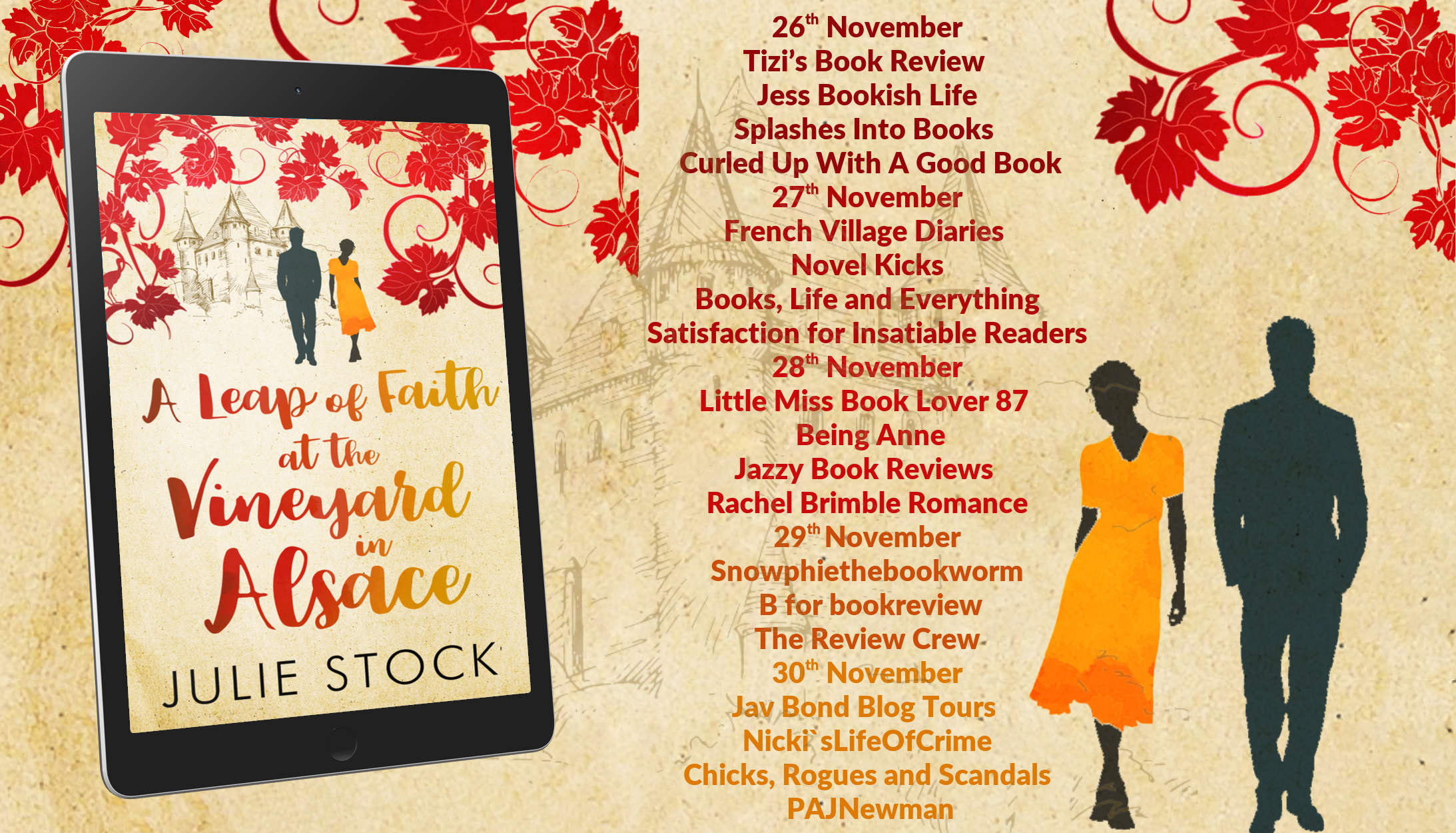
It’s winter at The Vineyard in Alsace, and wedding bells are in the air

How do you know when you’re ready for love?

Ellie Robinson has spent her life running from commitment following the breakdown of her parents’ marriage when she was young. She doesn’t believe in happy ever afters and the last thing she wants is to settle down in one place when she could be travelling the world.

Having moved from place to place throughout his childhood, Henri Weiss now calls the vineyard in Alsace home, and he loves the stability the vineyard and the people on it give him. While he enjoys travelling, it’s always good to come home again.

Following an extended travelling trip together, Ellie and Henri find their differences more marked than before, despite their love for each other being even stronger. Then a series of shocks in Ellie’s personal life throws things into turmoil, leaving Ellie unsure as to how to get everything she wants. And Henri facing the loss of the future he has dreamed of.

Can Ellie and Henri reconcile their very different desires and take a leap of faith on their love for each other? Will they get the happy ever after they’ve both been longing for?

Escape to The Vineyard in Alsace once again for this uplifting, romantic read and enjoy Christmas at Domaine des Montagnes.

Alsace has always held a fascination for me, not entirely logically. I only came across it in history class at school where its sole function seemed to be to be traded between the French and Germans like some territorial top trumps card but, you know, with real people and actual land. So, when Julie Stock’s latest novel came into my review pile, it would have been rude not to have a peek.

If I had known that this novel was the third in a trilogy, then I might have had second thoughts, but I’m very pleased I went ahead with reading and reviewing it any way.

What we have here is the perennial odd couple romance. Ellie and Henri are both decent, honourable people – but nevertheless – they are two people of very different characters. Ellie has the wanderlust in her DNA, Henri wants to stay rooted to his soil and his vineyard.

Personally, I want to do both but what do I know?

Add in the “events, dear boy, events” which have a tendency to beset us all – how’s that wanderlust working out for most of us over the last 24 months? – and you have a novel which zips along as light on the palate as a decent rosé and designed to warm your heart as the weather outside dips in temperature.

Stock shifts the narrative between her two protagonists, allowing the reader an insight into their thoughts and feelings which gives a clarity to their perspectives and acts as weight to their seemingly irreconcilable differences. This can be a high wire act for an author – if the voices are not distinct enough, it grates, if the events too trivial, the characters come off as whiny. Stock navigates these potentially choppy waters with aplomb.

As the days draw shorter in the northern hemisphere (pretty drastically if, like me, you live further north than Oslo) and as variant 3,000-and-something of the dreaded C-lurgy appears on our festive horizons, being encouraged by a charming little novel such as this to remember that the sun on your back, a loved one by your side and a glass of the good stuff in your hand is a path to happiness you can’t go wrong from.

Purchase Links

A Leap of Faith – mybook.to/ALeapofFaith

The 3 book series page – mybook.to/ddmseries

Author Bio –

Julie Stock writes contemporary feel-good romance from around the world: novels, novellas and short stories. She published her debut novel, From Here to Nashville, in 2015, after starting to write as an escape from the demands of her day job as a teacher. A Leap of Faith at the Vineyard in Alsace is her eleventh book, and the third in the Domaine des Montagnes series set on a vineyard.

Julie is now a full-time author, and loves every minute of her writing life. When not writing, she can be found reading, her favourite past-time, running, a new hobby, or cooking up a storm in the kitchen, glass of wine in hand.

Julie is a member of the Romantic Novelists’ Association and The Society of Authors. She is married and lives with her family in Cambridgeshire in the UK.

Social Media Links –

Website

Twitter

No Coal Here Just Backstories to Be Mined

‘The Murky World of Timothy Wall’ by Ian McFadyen

TO WIN A COPY OF ‘THE MURKY WORLD OF TIMOTHY WALL’ FOLLOW THIS LINK

When the body of Timothy Wall, a Private Detective, is fo und in his office, the querulous Inspector Carmichael discovers some surprising revelations and curious contradictions about the dead man. Loved by many and seemingly despised by others in equal measure, Timothy Wall’s whole world seems to be strewn with paradoxes.   

This fast-moving whodunnit, based in the North West of England, sees McFadyen’s detective team tackle one of their most taxing cases yet.

Who killed Timothy Wall? Will one of his numerous lovers or ex-partners provide the answer to the conundrum? And what about Tim’s involvement with the brothers Baybutt, the local bookmakers. Do they know more than they are telling?

As Carmichael and his team seek answers to these questions it becomes crystal clear that all was not quite how it seemed in the life of Timothy Wall. This, the nineth book in the Carmichael series, is full of twists, turns and red herrings that will keep the reader guessing right up to the bitter end. 

What is it about detective fiction that we like so much? I have no definitive answer, although like all great detectives I have my theories.

Something I do know is that I like the conclusion of the mystery, the detective proven correct, the world put to rights – at least for today.

I’m not sure what it was that attracted me to this latest in the Detective Carmichael series by Ian McFadyen. I’d not come across the stories before, I have no connection to Lancashire where they are set (in fact, to the best of my recollection, I’ve never been to Lancashire).

But, I do like a Private Investigator story and I do like a nice police procedural and here was a nice intersection of both: I was in.

Do I regret my choice? Not at all. The characters and setting are obviously well set after so many books and, as in Martin Walker’s Bruno Chief of Police novels which I have written about elsewhere, by now, they are living, breathing people in their own right. McFadyen approaches something like this with Carmichael’s family and his passion for his special pinotage wine.

And, for all Carmichael’s back story and intricate relationships with his colleagues, McFadyen is going to keep the story zipping along at pace and is not afraid to make sure the reader is never allowed to become bored.

Sometimes, the dialogue does tip a little towards the stilted for my taste, but in a novel of well fleshed out characters, with convincing motivations, backstories and plenty of mysteries to be unravelled, this is a small complaint which shouldn’t deter anyone from exploring the world of McFadyen’s Carmichael universe.

Purchase Links

Book Guild – https://www.bookguild.co.uk/bookshop/book/302/The%20Murky%20Wall%20of%20Timothy%20Wall/

Bookshop.org – https://uk.bookshop.org/books/the-murky-world-of-timothy-wall/9781913913441

Waterstones – https://www.waterstones.com/book/the-murky-world-of-timothy-wall/ian-mcfadyen/9781913913441

Foyles – https://www.foyles.co.uk/witem/fiction-poetry/the-murky-world-of-timothy-wall,ian-mcfadyen-9781913913441

WHSmith – https://www.whsmith.co.uk/products/the-murky-world-of-timothy-wall/ian-mcfadyen/paperback/9781913913441.html

Amazon – https://www.amazon.co.uk/Murky-World-Timothy-Wall/dp/1913913449/ref=sr_1_1?dchild=1&keywords=The+Murky+World+of+Timothy+Wall&qid=1632920646&sr=8-1

Book Depository – https://www.bookdepository.com/The-Murky-World-of-Timothy-Wall-Ian-McFadyen/9781913913441

Author Bio –

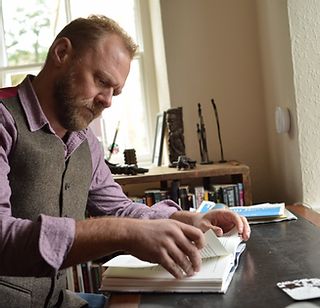
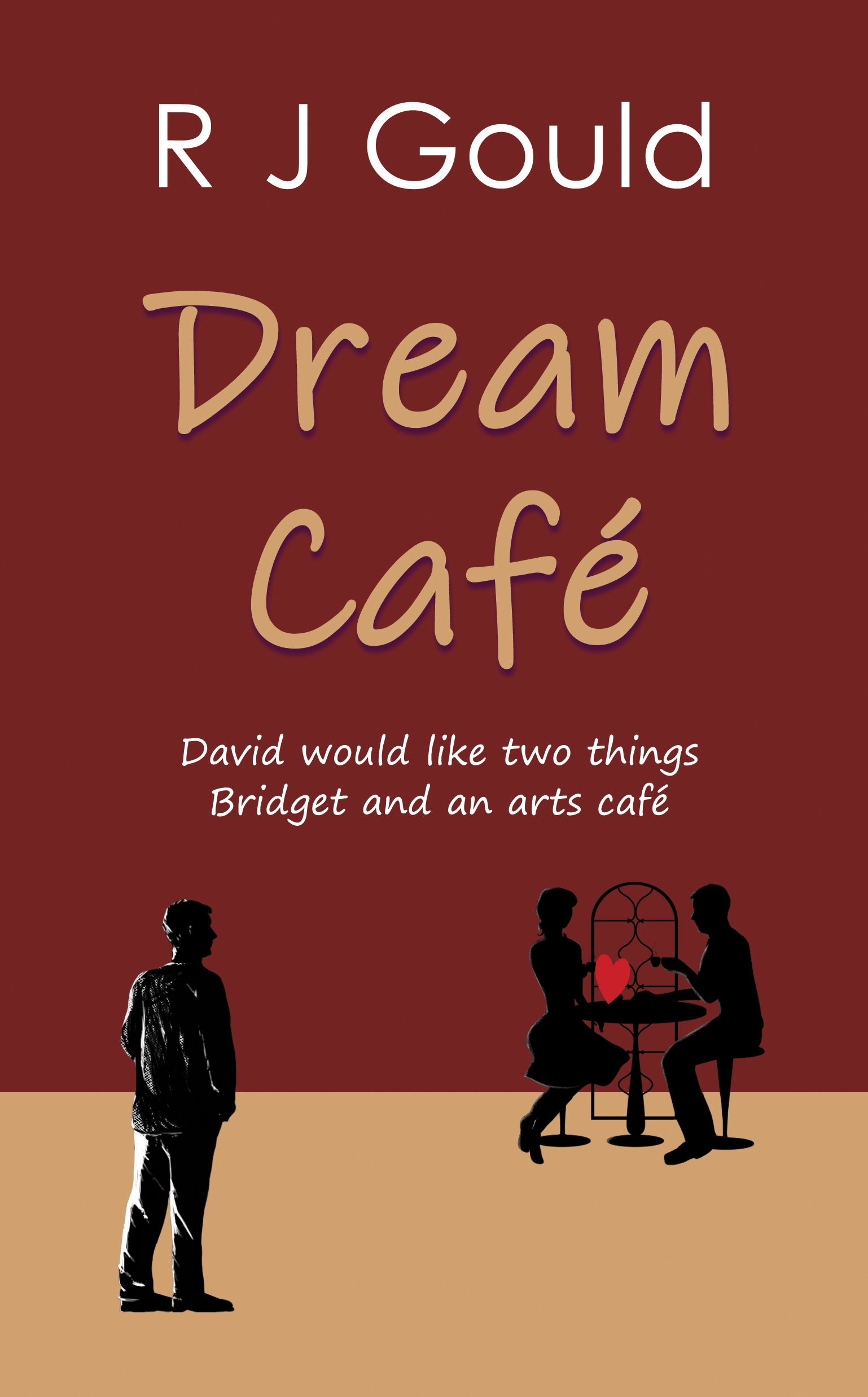
AUTHOR — Author Ian McFadyen visits Ulverston Library to talk to local people about his books. Thursday 30th October 2014. HARRY ATKINSON REF:

Ian McFadyen grew up in Lancashire, the setting for the Carmichael series of detective novels. Having studied marketing at Huddersfield University he had a 30-year career in sales and marketing with leading global companies in the electronics industry before switching full-time to writing. He has published eight books in the Carmichael series so far, several of which are available in large print, two have been translated and published in Italian and two in Czech. He lives in Bishop’s Stortford, Herts.

Social Media Links –
FB : Facebook.com/ianmcfadyenauthor

Twitter : @ianMcFadyen1

Love in a Lane – Publication Day Delights As Easy As 1, 2, 3!

Love Heart Lane Boxsetby Christie Barlow

Don’t miss this gorgeous eBook boxset of the first three novels in Christie Barlow’s bestselling Love Heart Lane series – also including a bonus Christmas short story!

Love Heart Lane – where friends are there for you no matter what

Love Heart Lane

When Flick Simons returns to the cosy village of Heartcross she only expected to stay for a few days. The white-washed cottages of Love Heart Lane might be her home, but the place holds too many painful memories, and of one man in particular – Fergus Campbell.

Foxglove Farm

Isla and Drew Allaway appear to have the perfect life – a strong marriage, two beautiful children and their picture-perfect home, Foxglove Farm.
But, new mum Isla is struggling. When she discovers that Drew has been keeping secrets from her, Isla has to face losing the home they all love.

Clover Cottage

When Vet Rory Scott inherits ramshackle Clover Cottage in the quaint village of Heartcross, Allie MacDonald just knows this is their happy ever after. A place to call home with the man she loves – it’s her dream come true!
Until Rory drops a bombshell. He loves Allie but he has dreams of his own to follow – to live and work in Africa. Clover Cottage will have to wait just a little longer…

Plus the exclusive short story –  Christmas at Heartcross Castle.

Celebrate Christmas with all your favourite residents from Love Heart Lane – a short Christmas story not to be missed! Merry Christmas! X

Purchase Links

UK – https://www.amazon.co.uk/gp/product/B09B4R97YL/

US – https://www.amazon.com/gp/product/B09B4R97YL/

About Christie Barlow

Christie Barlow is the number one international bestselling author of fifteen romantic comedies including the iconic Love Heart Lane Series, A Home at Honeysuckle Farm and Kitty’s Countryside Dream. She lives in a ramshackle cottage in a quaint village in the heart of Staffordshire with her four children and two dogs.

Her writing career has come as a lovely surprise when Christie decided to write a book to teach her children a valuable life lesson and show them that they are capable of achieving their dreams. Christie’s dream was to become a writer and the book she wrote to prove a point went on to become a #1 international bestseller in the UK, USA, Canada and Australia.

When Christie isn’t writing she co-presents The Book Show on Radio Northwich, enjoys playing the piano, is a keen gardener and loves to paint and upcycle furniture.

Christie is an ambassador for the @ZuriProject alongside Patron of the charity, Emmerdale’s Bhasker Patel. They raise money and awareness for communities in Uganda.

Christie loves to hear from her readers and you can get in touch via Twitter, Facebook and Instagram.

Instagram: https://www.instagram.com/christie_barlow/?hl=en

Twitter @ChristieJBarlow 

Facebook page Christie Barlow author

50 Shades of Monarch of the Glen

‘Highland Games’ by Evie Alexander

A fiery heroine, a Scottish god, a cabin, a castle, and enough heat to warm the coldest Scottish winter…

Highland Games is an unputdownable, enemies-to-lovers, romantic comedy, with sparkle and sizzle and a guaranteed happy ending. This sexy, witty, debut from Evie Alexander will have you laughing, swooning, and staying up way past your bedtime…

Perfect for fans of Sally ThorneTalia Hibbert, Sophie Kinsella, and Helen Hoang. If you’re looking for a riotous romantic comedy with plenty of heat, then Highland Games is for you!

♥♥♥ Welcome to Kinloch, and the hottest winter Scotland’s ever seen. ♥♥♥

Zoe’s always played it safe, just as her parents wanted. But when her great-uncle dies and leaves her a ramshackle cabin in the Scottish Highlands, she decides it’s time to change her life.

Upping sticks seems like a good idea in her cosy flat in London, but the reality is very different. There’s no electricity or running water, the roof leaks and there’s no front door. If that wasn’t bad enough, she’s moved up in the depths of winter and her scorching hot neighbour wants her out.

Rory’s got a fifty thousand tonne problem. If he can’t make Kinloch castle profitable, he’s out of a job. He needs a clear head, but there’s someone living in the cabin he saw as his own and she’s turned his world upside down.

Rory needs Zoe out of Scotland, and out of his life. The trouble is, she has no intention of leaving.

Let the games begin…

Some books come with a bit of a health warning for me as a reader. I am a book blogger based in the Highlands – coincidentally located about an hour of Inverness as is the setting for this novel.

So, when Evie Alexander’s novel came across my door I was curious to see how she was going to handle the Englishwoman incoming to the Highlands – because, spoiler alert, incomers are not always universally welcomed up here.

Again, I should know, I am one. And there are plenty of my fellow compatriots who would do well to learn to shut their yaps.

So, aside from spending a vast amount of time trying to geolocate Alexander’s model for the village of Kinloch (unsuccessfully, you know I think this might be fiction?) I can tell you that Highland Games is a delight. Oh and that Zoe is exactly the sort of heroine who would be welcomed in the north.

Yes, she has the unrealistic expectations of how much it will cost to do up her dilapidated semi-bothy hovel that many do, but she also wants to fit in and respects the people and the location.

Alexander captures beautifully the warmth of Highland hospitality and the near food coma a visit to a local family can induce. She also captures something of the sadness of many of the country estates which are falling to wrack and ruin.

Obviously, what she is also does is weave a cinematic will-they/they-definitely-will-but-it’s-just-a-matter-of-time-until-they-get-over-themselves romance between free spirited Zoe and preposterously hunky, good with his hands – in every sense – Rory.

Honestly, the description was like looking in a mirror. We all look like that up here.

‘Highland Games’ does have the same issue which novels of this form and genre have: in order to keep the protagonists away from jumping on each other, both have to be incapable of just saying how they feel and this can grow increasingly implausible. Alexander navigates this with the very effective solution of including a hefty dollop of slapstick comedy which is a delight.

Overall, ‘Highland Games’ is a debut of astonishing assuredness and I really believe that Evie Alexander will return with more novels which I hope will have the same lightness of touch, smoothly flowing dialogue and, with any luck, bucolic Highland setting.

Pre-order Link – https://amzn.to/3la37GY

Author Bio

Evie Alexander is the author of sexy romantic comedies with a very British sense of humour. She takes a method approach to her work, believing her capacity to repeatedly fail at life and love is what has given her such a rich supply of material for her writing.

Her interests include reading, eating, saving the world, and fantasising about people who only exist between the pages of her books. She lives in the West country with her family.

Website: https://eviealexanderauthor.com/

Facebook: https://www.facebook.com/eviealexanderauthor

Instagram:  https://www.instagram.com/eviealexanderauthor/

Twitter: https://twitter.com/Evie_author

Goodreads: https://www.goodreads.com/author/show/21611777.Evie_Alexander

BookBub: https://www.bookbub.com/profile/evie-alexander

Pinterest: https://www.pinterest.co.uk/eviealexanderauthor/

Giveaway to Win a signed copy of Highland Games, Shortbread and more… (Open to UK Only)

Prize is a signed copy of Highland Games, Exclusive postcard and bookmark, Personalised heart & Shortbread

*Terms and Conditions –UK entries welcome.  Please enter using the Rafflecopter box below.  The winner will be selected at random via Rafflecopter from all valid entries and will be notified by Twitter and/or email.

If no response is received within 7 days then Rachel’s Random Resources reserves the right to select an alternative winner. Open to all entrants aged 18 or over.  Any personal data given as part of the competition entry is used for this purpose only and will not be shared with third parties, with the exception of the winners’ information.

This will be passed to the giveaway organiser and used only for fulfilment of the prize, after which time Rachel’s Random Resources will delete the data.  I am not responsible for despatch or delivery of the prize.

<a class=”rcptr” href=”http://www.rafflecopter.com/rafl/display/33c69494445/&#8221; rel=”nofollow” data-raflid=”33c69494445″ data-theme=”classic” data-template=”” id=”rcwidget_np1g8hk5″>a Rafflecopter giveaway</a>

https://widget-prime.rafflecopter.com/launch.js

OR if you don’t like html or are on WordPress, but if you are Bookstagram only please ignore the giveaway!

http://www.rafflecopter.com/rafl/display/33c69494445/?

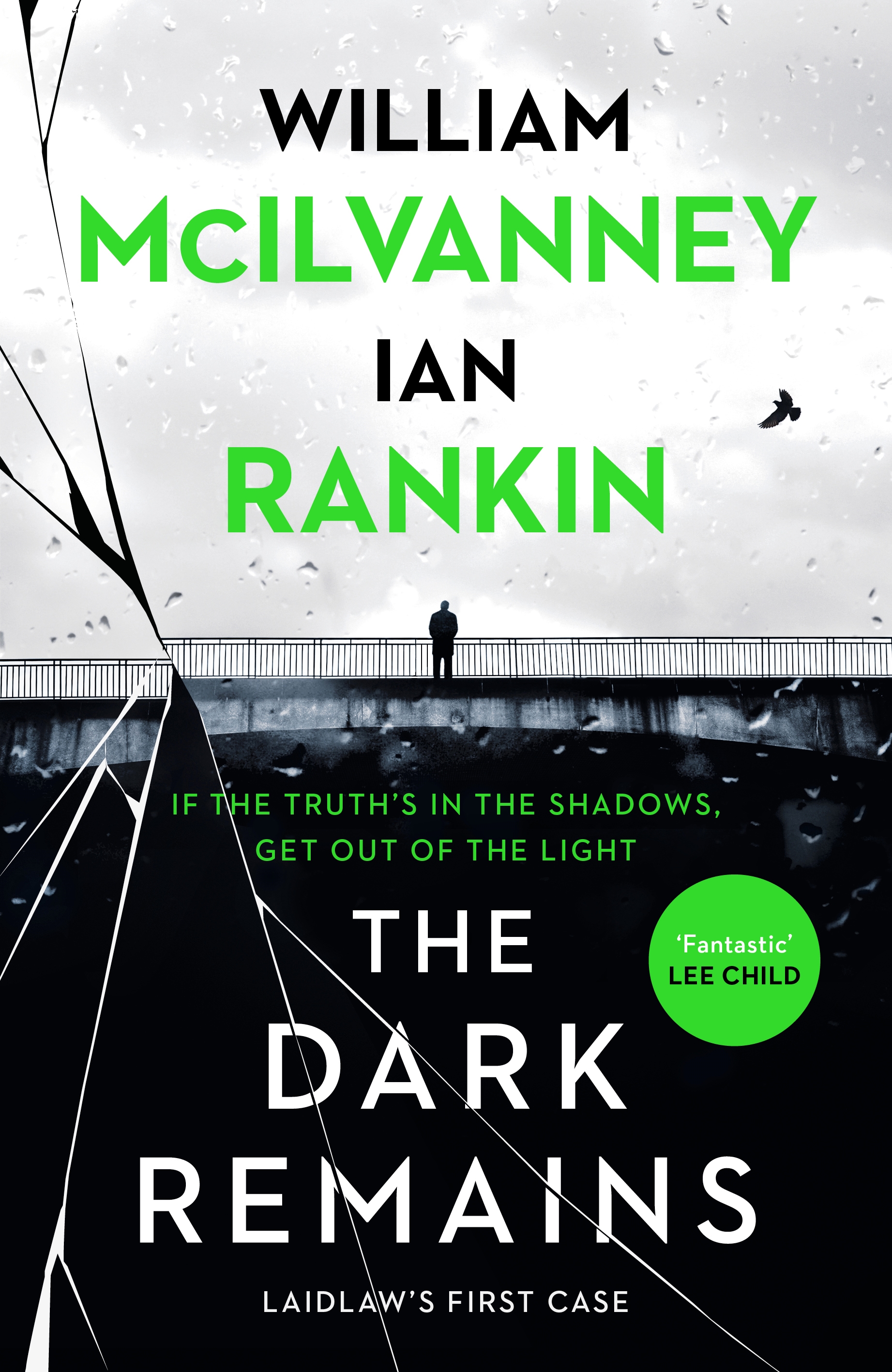
Nothing Stale About These Remains

‘The Dark Remains’ by Ian Rankin and William McIlvanney

If the truth’s in the shadows, get out of the light …

Lawyer Bobby Carter did a lot of work for the wrong type of people. Now he’s dead and it was no accident. Besides a distraught family and a heap of powerful friends, Carter’s left behind his share of enemies. So, who dealt the fatal blow?

DC Jack Laidlaw’s reputation precedes him. He’s not a team player, but he’s got a sixth sense for what’s happening on the streets. His boss chalks the violence up to the usual rivalries, but is it that simple? As two Glasgow gangs go to war, Laidlaw needs to find out who got Carter before the whole city explodes.

William McIlvanney’s Laidlaw books changed the face of crime fiction. When he died in 2015, he left half a handwritten manuscript of Laidlaw’s first case. Now, Ian Rankin is back to finish what McIlvanney started. In The Dark Remains, these two iconic authors bring to life the criminal world of 1970s Glasgow, and Laidlaw’s relentless quest for truth. (Synopsis courtesy of Canongate)

Ok, I’m going to start with a caveat: never have I been more crabbit about a book review than this one.

As a Scotland-based book blogger, I have never chased harder, nor gone through so many channels or pulled as many puny strings as I have at my feeble disposal (short of messaging Rankin himself directly on social media. That just seemed icky) than I did when trying to get hold of an advanced copy of this book.

After all, I’m a middle aged white guy with a blog and I’m definitely in the top six million people in Scotland who blog about books. Don’t they know who I am?

No, they don’t. And I didn’t get a copy. And I was gutted. ‘Bugger them,’ I thought. I’m sure not having a review from me will decimate sales.

But it’s Ian Rankin. And William McIlvanney. And the audiobook is read by Brian Cox.

Ok, three of Scotland’s finest united? I crumpled like a gangster under a Jack Laidlaw interrogation.

Rankin is, in my irrelevant opinion, the best crime writer working today and joins a tiny list of authors who get bought no matter what. I have written about my admiration of Rankin’s Rebus series elsewhere, but here it bears repeating: he’s a writer who’s work I believe is going to be read in hundreds of years and outlive the ridiculous “literary” fiction which does nothing to accurately reflect its era and is dull to boot.

So, the best of the best, polishing off the original and the best in William McIlvanney.

The first piece of close reading (comprehension for those not in Scotland or of a certain vintage) I taught was an extract from ‘Laidlaw’. To this day, that novel remains a revelation in the use of simile and metaphor and the prose crackles with impactful imagery.

In these types of literary Frankensteins, it’s always tempting to spend a chunk of the novel trying to spot the joins.

The references to contemporary politics, the issues with Nixon and the creeping Americanisation of Scotland feels Rankinesqe.

Metaphors like “a hole deep enough to hold a coffin,” feels like vintage McIlvanney. I suspect this is the sort of case where I’m wrong on both counts.

But, mainly, who cares? This is the godfather being helped to posthumous glory by the pupil who became the master.

If I have a criticism, it’s actually with the production of the audiobook. The lack of spacing between chapter and even paragraph breaks means that it sounds like Cox has forgotten the words and is being rushed to catch up.

But this is a trifle and his performance is still excellent.

So, I’m pleased that I got over my mardy response to my rejections. Because this is the best in the business at the top of their game.

Highly, highly recommended.

Purchase Links

Bookshop.org

Waterstones

Authors

Ian Rankin

Born in the Kingdom of Fife in 1960, Ian Rankin graduated from the University of Edinburgh in 1982, and then spent three years writing novels when he was supposed to be working towards a PhD in Scottish Literature.

After university and before his success with his Rebus novels, Ian had a number of jobs including working as a grape-picker, a swineherd, a journalist for a hi-fi magazine, and a taxman. Following his marriage in 1986, he lived briefly in London where he worked at the National Folktale Centre, followed by a short time living in France, before returning to Edinburgh.

Ian Rankin has been elected a Hawthornden Fellow, and is also a past winner of the Chandler-Fulbright Award. He is the recipient of four Crime Writers’ Association Dagger Awards including the prestigious Diamond Dagger in 2005. In 2004, Ian won America’s celebrated Edgar Award for Resurrection Men. He has also been shortlisted for the Edgar and Anthony Awards in the USA, and won Denmark’s Palle Rosenkrantz prize, the French Grand Prix du Roman Noir and Germany’s Deutscher Krimipreis.

Ian Rankin is also the recipient of honorary degrees from the universities of Hull, Abertay, St Andrews and Edinburgh as well as The Open University. In 2019, he donated his archive of over 50 boxes of manuscripts, letters and paperwork to the National Library of Scotland.

Ian has received an OBE for services to literature, opting to receive the prize in his home city of Edinburgh, where he lives with his wife and two sons. (Biography courtesy of Hachette)

William McIlvanney

Photo by Ian Atkinson, courtesy of http://www.canongate.co.uk

William McIlvanney’s first novel, Remedy is None, won the Geoffrey Faber Memorial Prize and with Docherty he won the Whitbread Award for Fiction. Laidlaw and The Papers of Tony Veitch both gained Silver Daggers from the Crime Writers’ Association. Strange Loyalties, the third in the Detective Laidlaw trilogy, won the Glasgow Herald’s People’s Prize. He died in December 2015. (Biography courtesy of Canongate)

Inheritances and Italian Amore

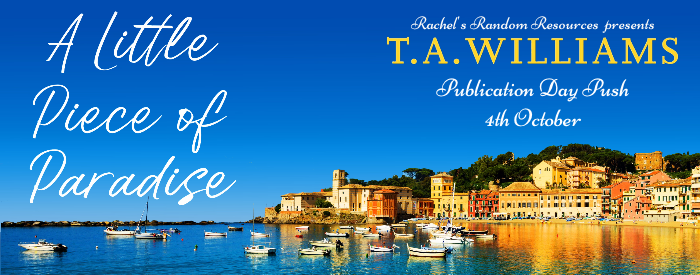
‘A Little Piece of Paradise’ by TA Williams

The inheritance of a lifetime… with a catch

When Sophie’s uncle leaves her a castle in the Italian Riviera in his will, she can’t believe her luck. The catch? She and her estranged sister, Rachel, must live there together for three months in order to inherit it.  

Having worked in Rome for four years, Sophie’s excited to revisit to Italy, even if it reignites memories of a cheating ex who soon learns of her return and wants to rekindle their spark. Sophie realises that distance does indeed make the heart grow fonder – but for her friend back home, Chris, who she discovers is more to her than just a friend.

With the clock ticking, can Sophie and Rachel stick it out and heal old wounds, or are the sisters destined to go their own way at the end of the three months? And does Chris feel the same way about Sophie as she does for him?

A beautiful story of romance and sisterhood, perfect for fans of Alex Brown and Lucy Coleman.

Regular readers of this blog (Oh, so you’re the one) will know that I like a nice escapist romance novel from time to time. I understand that as a man, demographically, this puts me outside the realm of the usual purchasers of such literature.

However, there is clearly at least one other fan of the genre in author TA Williams. Here, Williams has taken a fairly well trodden path – the inheritance with the millstone bequest attached – and added in the tantalising reward of an Italian villa worth over a million Euros.

The catch? Being shackled to an estranged sister for three months (shackled metaphorically, rather than literally. This becomes a very different novel if not.)

As with my favourite novels from this genre, the food is the described in great detail, the wine as enchanting as the scenery and love affairs flare up and create havoc as the principle characters navigate this taxing situation.

Between the food, the wine, the amore and the villa, this is a novel to charm the reader and its 300-odd pages zip by. Sometimes the dialogue can read as a little stilted, especially in the early chapters where the need for exposition can make some of the characters sound a little wooden, but this is a minor quibble in a novel of enormous charm and lightness of touch. Also, any novel with a character as fully rounded and obviously loved as Jeeves the Labrador is a delight and can do no wrong!

Purchase Links

UK – https://www.amazon.co.uk/dp/B09F5QJQDZ

US – https://www.amazon.com/dp/B09F5QJQDZ

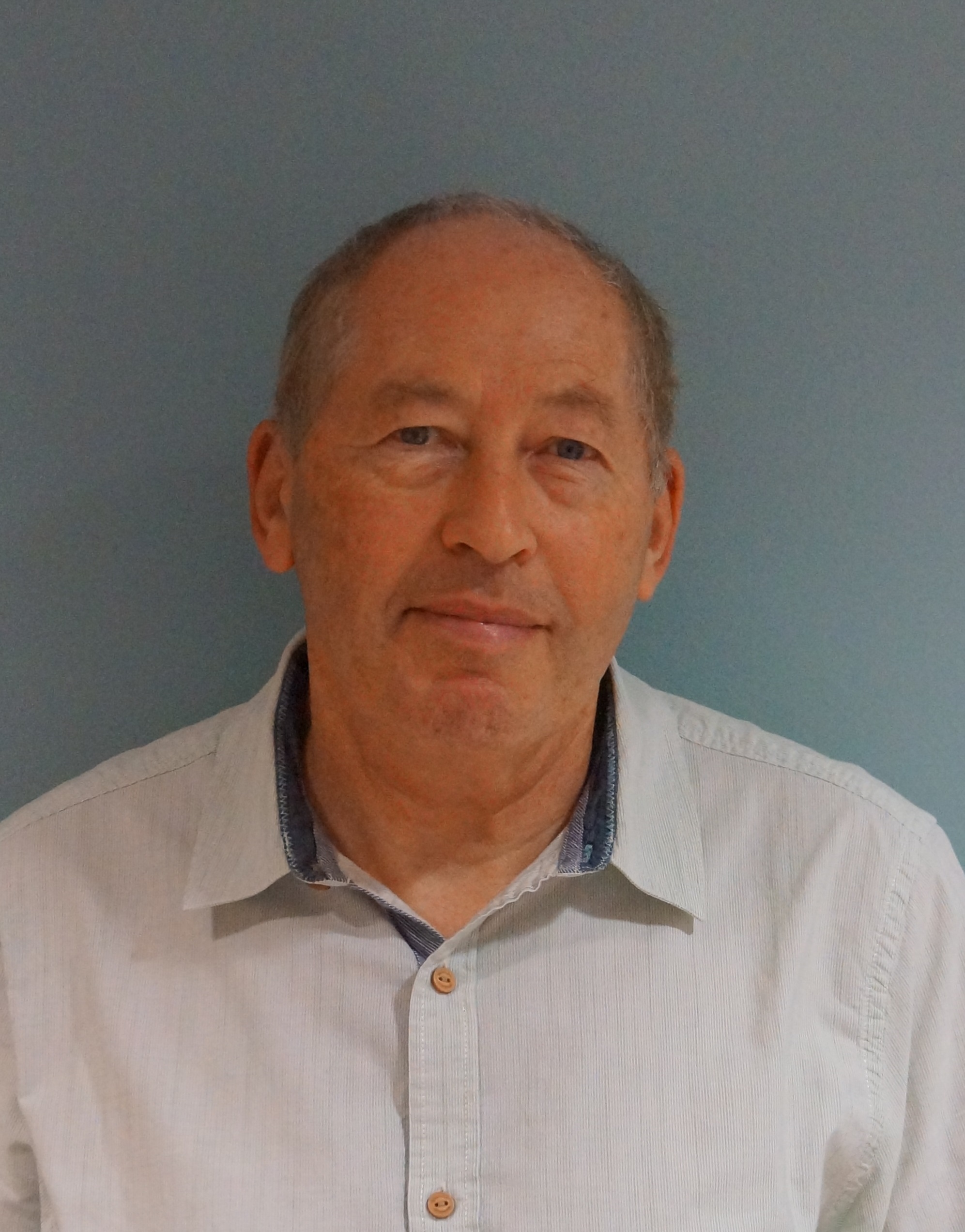
Author Bio – I’m a man. And a pretty old man as well. I did languages at university a long time ago and then lived and worked in France and Switzerland before going to Italy for seven years as a teacher of English. My Italian wife and I then came back to the UK with our little daughter (now long-since grown up) where I ran a big English language school for many years. We now live in a sleepy little village in Devonshire. I’ve been writing almost all my life but it was only seven years ago that I finally managed to find a publisher who liked my work enough to offer me my first contract.

The fact that I am now writing escapist romance is something I still find hard to explain. My early books were thrillers and historical novels. Maybe it’s because there are so many horrible things happening in the world today that I feel I need to do my best to provide something to cheer my readers up. My books provide escapism to some gorgeous locations, even if travel to them is currently difficult.

Social Media Links –
Website: www.tawilliamsbooks.com

Twitter: https://www.twitter.com/tawilliamsbooks

Facebook: https://www.facebook.com/TrevorWilliamsBooks/

Catering to the Romantics

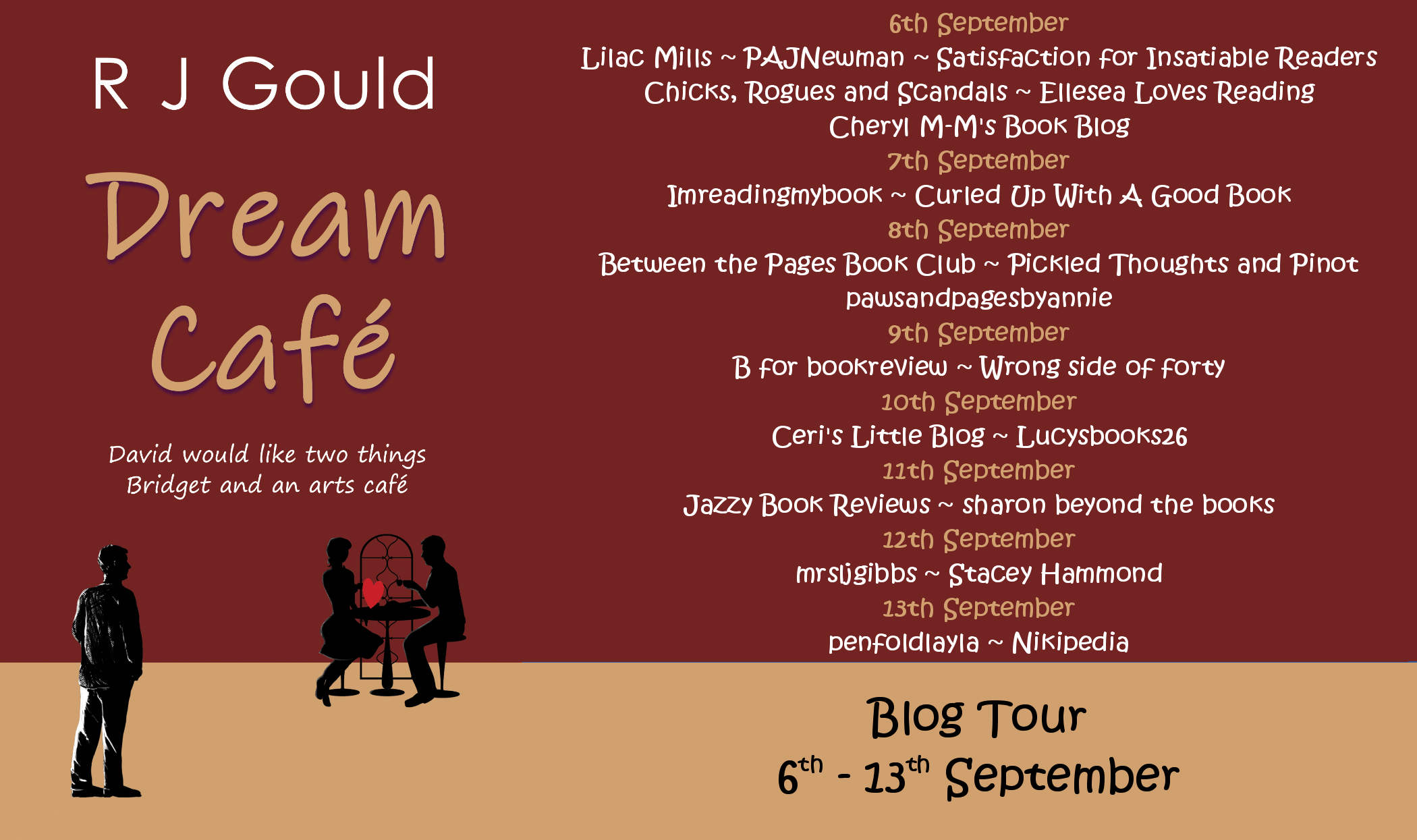
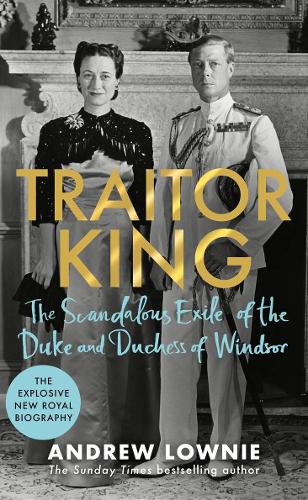
‘Dream Café’ by RJ Gould

“Why on earth am I here?” David wonders as he observes the juvenile antics of ex-classmates at the twenty-five year school reunion. Then he sees Bridget.

David draws up a list of all that he hopes to achieve to kick-start a new life now that his wife has moved in with his best friend – his ex-best friend. A relationship with Bridget is top of the list, opening an arts café is a close second.

Formidable women – an unfaithful wife, a reckless teenage daughter, a boss from hell, a disapproving policewoman – seem like insurmountable obstacles.

But it’s still OK to dream, isn’t it?

I don’t think I’m giving too much away to confess that I have a birthday coming up in the next couple of weeks. A “big” one. One with a zero at the end.

As it happens, it is a “big” birthday which puts me in close proximity to David, the lead character of ‘Dream Café’. Having decided against attending my own school reunion (to paraphrase a friend’s response, he’d rather defecate in his hands and clap) I really felt for the character as half remembered school contemporaries lunge at him as the novel opens.

As the book progresses, we learn that poor David has quite the complicated back story, with all sorts of unpleasant behaviour having been dealt to this rather nice, if vague, protagonist.

Personally, I think a nice romantic comedy which nips along with ease of reading and light touch charm and ‘Dream Café’ has this in abundance. David is a hero we can root for and, even including the necessary ups and downs which must befall all characters in this genre, it is comforting to know that all will – up to a point – turn out right with the world.

Incidentally, I too have a secret dream to abandon my career and relaunch ala David – but perhaps I’ll have to wait until nearer his age to do so 😉

Purchase Links –

Author Bio –

Richard writes under the pseudonym R J Gould and is a (rare male) member of the Romantic Novelists’ Association (RNA). His first novel was shortlisted for the Joan Hessayon Award following his participation on the RNA New Writers’ Scheme. Having been published by Headline Access and Lume Books, he now self-publishes.

He writes contemporary literary fiction about relationships, loosely though not prescriptively within the Romance genre, using both humour and pathos to describe the tragi-comic journeys of his protagonists in search of love. ‘Dream Café’ is his sixth novel, following ‘The Engagement Party’, ‘Jack and Jill Went Downhill’, ‘Mid-life follies’, ‘The Bench by Cromer Beach’ and ‘Nothing Man’. [It is a rewrite of ‘A Street Café Named Desire’].

Ahead of writing full time, Richard led a national educational charity. He has been published in a wide range of educational journals, national newspapers and magazines and is the co-author of a major work on educating able young people. He lives in Cambridge, England.

Social Media Links –
Website:                           http://www.rjgould.info

Twitter:               https://twitter.com/RJGould_author

Email:                                news@rjgould.info

Facebook:                         https://www.facebook.com/RJGouldauthor

Instagram:                        https://www.instagram.com/rjgould_author

Question and Answer with Andrew Lownie

If you would like to read a review of ‘The Traitor King’, you can read about it here

Between Stalin’s EnglishmanThe Mountbattons and now The Traitor King you have investigated and peeled away layers of the twentieth century British establishment. What do you think it is which attracts you to this sort of topic?

I’m interested in revisionist biography, taking a well-known subject and looking at them with a new angle – a portrait of a marriage as in The Mountbattens , the consequences of a seismic event such as the Abdication in the case of Traitor King – and based on fresh  sources. That can be private archives or  interviews with people who knew the subject but largely it depends on public archives and using FOI requests. This was crucial with regard to the Guy Burgess biography and, never a natural  rebel, I was shocked by the way government departments failed to adhere to Freedom of Information requests or honour the various Public Record Acts. I became increasingly enraged by the lies and obfuscation but also the fact that cover ups have simply continued. The White Paper into Burgess & Maclean’s disappearance was known as the Whitewash Paper and I became increasingly interested in how the narratives were shaped by subject or government. This became very apparent with the way Mountbatten curated his life by cooperating with tame journalists and writers and denying access to anyone who might be sceptical of his PR line. It was a pattern repeated by the Windsors. For a biographer this is fascinating. Here’s the story they want you to believe , such as we lived happily ever after, and here’s the reality.

I understand that this might seem flippant, but I mean it seriously: how do you get the time? Not only to write, but also to do the archival research necessary to produce books of this level of detail, especially when maintaining a difficult day job and then mounting various campaigns.

It is time-consuming because, as you say, I spend a lot of time on research , which I do almost entirely myself unless another language is required, yet have a demanding day job representing some 200 authors as a literary agent. The answer is I work long hours every day and I work quickly. I tend to write the books in a few months without few revisions because my research is thorough and I know exactly how I’m going to tell the story. I think the fact that I write against tough deadlines gives a certain narrative pace to the books. The research has been particularly difficult for Traitor King because archives were closed and many remain so which is very frustrating but US archives, in particular, but also the Churchill College Archives in Cambridge, provided digital access .

What is a typical writing day for you?
There is no typical day. About six months before the book is due, irrespective of where the research is because one can always do more,  I sit down to aim to write 4-5,000 words, a chapter, each day. Usually that’s after a day’s work at the agency  and I’ll write into the night. During this period I’ll try not to do agency work at weekends so I can have a clear two day run to immerse myself properly in the chapter. If I’m struggling at one point, I’ll just keep writing leaving a gap to be filled.The key is to keep putting words on the page even if it doesn’t look very fluent. One can always polish later.

As well as your writing and literary agency, you have been a vocal campaigner for Freedom of Information, counteracting measures by the UK government to destroy documents as well as latterly, for the University of Southampton to release the diaries of the Mountbatton. What are the latest on this and what can people do to help?

I feel very strongly that our history is being censored and we cannot tell the truth about the past unless we know the full picture. I’m very concerned that all the documents which by law should be in the National Archives  – we now have a 20 year rule – are not there, that many are ‘temporarily retained’ by departments for years and when sent  to the archives have been heavily weeded and that a high proportion of documents are destroyed without any record of their contents being kept.. Much of this has nothing to do with national security but rather with an over-cautious  culture of secrecy in Whitehall and to cover up embarrassment. In this country the attitude of those dealing with research requests is ‘how can we keep this secret’, in the US it’s ‘how can I help you in your research’.

I’ve just mounted a six year campaign to ensure that the diaries and letters of Dickie and Edwina Mountbatten, bought for £4 million with public monies or in lieu of tax on the basis they would be ‘available publicly to all’ , are released. The Information Commission ruled in 2019 that they should be opened but Southampton University and the Cabinet Office appealed and managed with excuses to delay a hearing  until November this year. Their approach was to hope I would give up because my book was finished and that their pockets were deeper than mine. I refused to be bullied into submission. So far it has cost me £250,000 in legal fees – all my earnings and savings- so heaven knows what public funds were spent  by the Cabinet Office.

In May this year, after another delaying tactic by Southampton and the Cabinet Office,  I had to crowdfund another  £50,000 to ensure I could go to the hearing. People, most of whom I didn’t know, contributed because they could see the important principles at stake – freedom of speech, access to archives, the abuse of State power.

A media and parliamentary campaign, alongside pressure from my lawyers, has meant that some diaries from 1920-1960 have been released but they have been redacted and there is no sign of the diaries to 1980 or the couple’s correspondence. There also remain missing files in the inventory in the Mountbatten papers and no sign of the Edwina-Nehru correspondence. Much still needs to be done and those interested can help by joining the Campaign for Freedom of Information, lobbying MPS, writing letters to the paper and sharing the various horror stories on social media.

I’m not a natural conspiracy theorist but the destruction of documents and the restrictions placed upon academics to access records does seem Kafkaesque in its sinister implications. How structured and explicit do you think these policies are?

I think it is very calculated. Freedom of Information officers in government departments are trained in how to use exemptions to deny accessthey deliberately confuse requestors  by changing reference numbers or simply don’t answer.The stock response from the Met asking for files on the inter-war period is they don’t know if they have them because almost a hundred  years later they have still not been catalogued. We know for a fact that material going back to Victorian era is still held in the Hanslope archive outside London and it was only a court case that forced the Foreign Office to admit to the ‘migrated’ archive there relating to Mau Mau terrors of the 1950s. Another problem is the regulator for Freedom of Information, the Information Commissioner, reports to the Cabinet Office who are one of the worst offenders for failing to answer FOI requests. The Cabinet Office simply cuts the ICO budget so they can’t do their job properly.

The Government use the excuse of resources but I would suggest they use their resources to open up papers rather than suppress them – we know the QCs used by the Cabinet Office and Southampton in our hearing cost £33,000 for a few days’ work.

I’ve heard you speak elsewhere of the way there seems to be a two tier system for historians and researchers in this country. Those willing to “tow the line” rewarded with access to releases, advanced sight and invitations to events beneficial to them whilst others labelled “difficult” are excluded. Do you think this is still the case?

Absolutely and it refers to both archivists and writers. It is noticeable that the archivists with gongs are those who ‘cooperate’ with the Government and I know plenty of well-known historians who are convinced they will be enobled  or knighted if they write supportive articles about the Royal Family, cosy up to the government of the day and diss anyone who takes a more independent line. It was revealing that no historian  came out in support of my campaign to open the Mountbatten diaries for everyone though it went to the heart of historical scholarship. Nor incidentally did many of the organisations set up to support free speech, support writers or academic. The two exceptions were EnglishPen and the Royal Historical Society.

Where are you on choosing your next project?

I have started a new book but am keeping quiet about it. With Traitor King, I told one of my authors and he promptly went and tried to do it himself hence the need to deliver quickly.

Author Biography

Andrew Lownie was born in 1961 and was educated in Britain and America. He read history at Magdalene College, Cambridge where he was President of the Union. He went on to gain an MSc at Edinburgh University and spend a year at the College of Law in London. After a period as a bookseller and journalist, he began his publishing career as the graduate trainee at Hodder & Stoughton. In 1985 became an agent at John Farquharson, now part of Curtis Brown, and the following year became the then youngest director in British publishing when he was appointed a director. He set up the Andrew Lownie Literary Agency in 1988.

Since 1984 he has written and reviewed for a range of newspapers and magazines, including The Times, Spectator and Guardian, which has given him good journalistic contacts. As an author himself, most notably of a biography of John Buchan, a literary companion to Edinburgh and a prize-winning biography of the spy Guy Burgess, he has an understanding of the issues and problems affecting writers.

He has acted as the literary agent to the international writers’ organisation PEN. In 1998 he founded The Biographers Club, a monthly dining society for biographers and those involved in promoting biography, and The Biographers’ Club Prize which supports first-time biographers. He has had a regular advice column in the writing magazine Words with Jam, written the entries on submitting to agents for The Writers Handbook and The Writers and Artists Yearbook, contributed to The Arvon Book of Life Writing and regularly gives talks on aspects of publishing.

Less A Frog Prince Than a Toad

Normal 0 false false false EN-GB X-NONE X-NONE

‘The Traitor King’ by Andrew Lownietraitor king

You can find an exclusive Q&A with author Andrew Lownie here

Drawing on extensive research into hitherto unused archives and Freedom of Information requests, it makes the case that the Duke and Duchess of Windsor were not the naïve dupes of the Germans but actively intrigued against Britain in both war and peace.

‘Traitor King’ reveals the true story behind the German attempts to recruit the Duke as a British Pétain; the efforts, by Churchill in particular, to cover this up; the reasons why the Duke, as Governor of the Bahamas, tried to shut down the  investigation into the murder of a close friend, and shines light on the relationship between the Duke and Wallis, revealing it to be far from the love story it is often assumed to be.

Lownie’s previous book with Bonnier Books UK, ‘The Mountbattens’, was a ‘Sunday Times’ bestseller and a Waterstones Book of the Year. (Synopsis courtesy of http://www.bonnierbooks.co.uk)

I’ve danced with a man, who’s danced with a girl, who’s danced with the Prince of Wales” went the lyrics to the popular1927 song by Herbert Farjeon and Harold Scott, performed by Elsa Lanchester.

After reading this incendiary work of revisionist history, perhaps we need to rework the lyrics to read, “I’ve danced with a man, who’s danced with a girl, who’s compromised national security with the Prince of Wales.”

If, like me, most of your knowledge of Edward VIII is derived from fictional portrayals – Edward Fox in ‘Edward and Mrs Simpson’, Guy Pearce in ‘The King’s Speech’ – then I think it’s fair to say that you will almost certainly be horrified by the portrait of Windsor which emerges in Andrew Lownie’s first class biography.

There are a number of reasons for this shock therapy for the reader. Firstly, Lownie –  an accomplished literary agent and power house behind several campaigns related to archives and freedom of information – is a powerhouse researcher. In this work he had gained access to previously unpublished memoirs by key characters in the narrative, as well as scoured the UK and US National Archives for previously unexplored resources.

Secondly, Lownie has an unparalleled knowledge and background with which to unpack his topic. His previous works: on Guy Burgess; on the Mountbattons and – to a lesser but relevant extent – John Buchan allow this Cambridge graduate to peel away the onion layers of how the British establishment really works and how it protects its own, obfuscates and evolves.

Finally, it deals with a clearly under explored aspect of this tale. Book of book, movie and TV show has dealt with the abdication – the run up to it, the emotional aftermath, the toll it took on the unsuspecting successor Bertie and his stoic daughter.

But little to nothing has been written of Edward and Wallis’ post-abdication roles. Along the way, he had uncovered enough salacious details of their sex lives to keep the most prurient reader happy whilst also painting a frankly horrifying portrait of the personalities of the two of the major figures of twentieth century history.

Edward emerges as a tone deaf man/child who literally could not be trusted. Secrets are shared with the Germans and his rampant anti-semitism continues, according to sources quoted here, throughout his entire life.

As Europe is falling and Hitler is sweeping away opposition, the nearly King embarks on his famous 1938 German Tour. “The couple arrived by train in Berlin at a station festooned with alternating Union Jacks and swastikas, to be met by Robert Ley, the head of the National Labour Front, [and] the foreign minister Ribbentrop.”

This is before we are treated the sheer tone deaf imagery of Edward and Simpson leacving for their “honeymoon in a convoy of cars to join the Simplon-Orient Express, which had been kept waiting for them. They were accompanied by Dudley Forwood, an attaché at the British Legation in Vienna… two cairn terriers, a pair of Scotland Yard detectives whose brief was as much to spy on as guard the Windsors, and 186 trunks and 80 additional items of luggage.” Modest, retiring and appropriate, they are not.

This is all rather good clean, if horrifying fun, but Lownie is not an author who allows his reader complacency. Just as one has adapted to a former monarch gnashing his teeth abroad, surrounded by unwise companion, but a sort of exasperatingly neutered Charles II before you are treated to the emotional consequences of this collusion.

Another day was spent in Dusseldorf for an industrial exhibit, where they toured a miners’ hospital and a concentration camp. Forwood later recalled, ‘We saw this enormous concrete building which, of course, I now know contained inmates. The duke asked, “What is that?” Our host replied, “It is where they store the cold meat.”’
Andrew Lownie has produced another first class piece of revisionist history which still contains the power to intrigue, shock and startle. If you read only one excoriating deconstruction of the power dynamics of the British state this year, make it this one.

Author Bio

Lownie study Andrew Lownie was born in 1961 and was educated in Britain and America. He read history at Magdalene College, Cambridge where he was President of the Union. He went on to gain an MSc at Edinburgh University and spend a year at the College of Law in London. After a period as a bookseller and journalist, he began his publishing career as the graduate trainee at Hodder & Stoughton. In 1985 became an agent at John Farquharson, now part of Curtis Brown, and the following year became the then youngest director in British publishing when he was appointed a director. He set up the Andrew Lownie Literary Agency in 1988. Since 1984 he has written and reviewed for a range of newspapers and magazines, including The Times, Spectator and Guardian, which has given him good journalistic contacts. As an author himself, most notably of a biography of John Buchan, a literary companion to Edinburgh and a prize-winning biography of the spy Guy Burgess, he has an understanding of the issues and problems affecting writers. He has acted as the literary agent to the international writers’ organisation PEN. In 1998 he founded The Biographers Club, a monthly dining society for biographers and those involved in promoting biography, and The Biographers’ Club Prize which supports first-time biographers. He has had a regular advice column in the writing magazine Words with Jam, written the entries on submitting to agents for The Writers Handbook and The Writers and Artists Yearbook, contributed to The Arvon Book of Life Writing and regularly gives talks on aspects of publishing. (Biography courtesy of www.andrewlownie.co.uk)

Questions and Answers with Simon Conway

You can read a review of Simon Conway’s new novel, ‘The Saboteur’ here

PAJNewman (PAJN): Jude Lyon is back and, once again, confronted with his nemesis Guy Fowle. I know last time you spoke about these characters representing your principled side and your inner psychopath and, this time out Fowle is even more dastardly than before. Do you see a long-term Bond/Blofeld, Smiley/Karla ying and yang relationship between these two?

Simon Conway (SC): It all depends whether one of them kills the other. I haven’t decided.

PAJN: Guy really is a villain – do you ever find yourself writing a chapter featuring him and think, “what’s wrong with me?!?” He certainly seems to be getting more evil as the books go on. I can’t see an emotional heart opening change in his behaviour any time soon but perhaps I’m being too harsh?

SC: Never. I refer you to the narrator of my second novel Rage who says: “There were so many things wrong with me I’d become frightened of drawing up a list of them, for fear of what I might learn.”

I like to believe in the possibility for redemption but for Guy Fowle it is hard to see what form that might take.

PAJN: The novel obviously has echoes of Covid with the vast majority of London being confined to their homes. Will Covid play a part in your future work do you think? And was it quite nice to play with parts of it, like the lockdown, but not have to deal with the dreary reality so much.

SC: I think that there is a place for COVID drama but I’m not sure that it’s what my readers are looking for. If it plays a part in my writing it will either to be through deliberate echoes – empty streets, deserted airports and overcrowded hospitals – or as a recent historical event.

PAJN: When we spoke last, you had taken about 18 months to write The Stranger. This novel is appearing much sooner and a great chunk of it was (I believe) written in combat zones. Would you mind speaking a little about how that works for you and how you manage to concentrate when doing such a difficult and dangerous day job?

SC: It’s not easy to balance a job that would consume very waking hour if you let it and the dogged business of writing novels. When it works, writing is a good way of switching off and relaxing. When it doesn’t, I can go days or weeks without writing and I feel like I’ve become slack and unmoored. I am fortunate that my job has allowed me to travel to some very interesting locations and meet memorable people. It is clear that has influenced my writing.

I did some of the final edits of The Saboteur in the evenings when I was in Libya last October. It’s not safe to go out at night so perfect for editing.

PAJN: In terms of Jude and Guy, do you think they will be back for a third outing? If so, do you have anything planned yet or are you working on anything different at the moment.

I’m working on a third instalment.

PAJN: The Saboteur is (I think this is correct) your seventh novel. Are you finding it easier to write as you get further in or is each a challenge in a different way?

SC: Yes, I think that it is becoming easier to write. I’m more confident of my skill. I spend less time agonising over the edit and as a consequence I’m more assured with the knife.

PAJN: The Stranger garnered some outstanding reviews and this must have been really pleasing. Has that changed how you approached the sequel and are you now under greater pressure for this instalment?

SC: I suppose I feel some pressure to keep up the pace.

Simon Conway has worked for The Halo Trust since 1998 clearing landmines all over the world.

PAJN: Does seeing landmines which have been placed indiscriminately by both governments and non-state actors, sometimes just to terrorise a populace, colour your view of human nature? Can you maintain a positive view of the world with the things you see in this role?

SC: It’s not an easy question to answer. By nature, I’m an optimist. I believe that it is possible to make the world better with sustained effort. I’ve seen evidence of that but my writing seems to tap into a more cynical and world-wearier vein. I worry that most people would burn their neighbour’s house down if goaded into it. That’s why those in power carry such a huge responsibility not to feed peoples’ worst prejudices.

PAJN: June this year saw an appalling loss of life in your team in Afghanistan. I was obviously so sorry to read about it and can only imagine how difficult it must have been. Is there anything practical that readers of yours can do to help and how are things out there now?

SC: In June this year eleven of my colleagues died in an attack on a remote demining camp in Baghlan Province. Later Islamic State claimed responsibility for the attack although it was more likely an armed robbery that went wrong.

We are all very concerned about the situation in Afghanistan and the safety of the two and half thousand HALO staff there, however we have been clearing mines and saving lives in Afghanistan for thirty years, including under Taliban rule, and we have weathered tough times before. Just because we don’t have troops there anymore doesn’t mean that the west can just give up on Afghanistan. No good will come of that. It is important that our government recognises that. Tell your MP!

Slightly less serious questions:

PAJN: What colour is Monday?

SC: Monday is blue, obvs

Who had the idea of coming up with a whisky to go with the advanced reader copies? Because it’s a superb idea!

SC: My editor at Hodder, Nick Sayers, is responsible for the whisky. He is being mysterious about how he acquired them.

PAJN: Last time I asked you what was the question you wished interviewers and readers would ask but never do and your answer was “is it possible to entertain and inform”. Has lockdown and the success of The Stranger altered the questions you get asked and how readers treat you?

SC: I have no idea why I thought that was a good question. I certainly don’t know the answer.

Author Bio

Simon Conway is a former British Army officer and international aid worker. He has cleared landmines and the other debris of war across the world.


As Co-Chair of the Cluster Munition Coalition he successfully campaigned to achieve an international ban on cluster bombs.


He is currently working as Director of Capability for The HALO Trust.


He lives in Edinburgh with his wife the journalist and broadcaster Sarah Smith. He has two daughters. (Biography courtesy of http://www.simonconwaybooks.com)