I’m Going Wait in the Midnight Hour, Until My Love Comes Tumbling Down

‘The Secret Hours’ by Mick Herron

Two years ago, a hostile Prime Minister launched the Monochrome inquiry, investigating “historical over-reaching” by the British Secret Service. Monochrome’s mission was to ferret out any hint of misconduct by any MI5 officer—and allowed Griselda Fleet and Malcolm Kyle, the two civil servants seconded to the project, unfettered access to any and all confidential information in the Service archives in order to do so.  

But MI5’s formidable First Desk did not become Britain’s top spy by accident, and she has successfully thwarted the inquiry at every turn. Now the administration that created Monochrome has been ousted, the investigation is a total bust—and Griselda and Malcolm are stuck watching as their career prospects are washed away by the pounding London rain.

Until the eve of Monochrome’s shuttering, when an MI5 case file appears without explanation. It is the buried history of a classified operation in 1994 Berlin—an operation that ended in tragedy and scandal, whose cover-up has rewritten thirty years of Service history. (Synopsis courtesy of Penguin Random House)

It is a truth universally acknowledged that a spy fan in need of the best should go searching for a Herron.

The poor man has lived with the lazy comparisons to Le Carre, the even less accurate Fleming associations and, from the more learned spy fans, Len Deighton references ever since ‘Slow Horses’ really caught fire around 6/7 years ago.

Since then, there has been Gary Oldman and Apple TV, Gold Daggers, silver dagger short listings and Theakston Old Peculier Crime Novels of the Year.

In short, if not an unbroken line of amassing ever-greater garlands, as close as any writer working in the field today.

And, of course, that means that each book becomes a higher wire act as bad actors (geddit?) wait for the fall. I noticed with Herron’s last book that there were one or two snotty reviews in certain publications, as the pendulum continues its full movement towards a back lash.

In fact, I wondered to what extent Herron’s decision to move this novel out of the Slough House milieu was a pre-emptive way of circumventing that entire conversation.

Or, perhaps, it was fab service? Amongst the learned literati of the Spybrary community (nicest place on the internet, best espionage books podcast I’ve ever encountered) there has long been talk of a desire to see Herron tackle a Cold War-set story. This desire seemed settled when the short story, ‘Standing by the Wall’ was released.

And then we heard that a standalone novel was to be released.

And, I’m delighted to report, the shimmering sceptres of lesser writer’s jealousies are going to have to wait a while longer for their enjoyment of the fall.

Because it’s too good. ‘The Secret Hours’ has got it all. It has the needle sharp observations on contemporary British politics, it has the Herron characters we’ve come to expect (fully rounded in that they’re broken on all sides) and it has the exactitude of language which means that no one turns a sentence to effect better – or uses the ambiguity of the English language to better plot effect. It also has the jokes – Apple TV gets a nod here, Gary Oldman there – which implies at least that all this praise has not gone to his head at least.

It is fair to say it is not really a standalone. It’s really an expansion of the “Herronverse”, taking the themes and events encountered in other pieces from the series and then re-visited from the angle of these new characters’ perspectives.

Basically: it’s a joy. It’s clearly Herron’s world; we just live in it. Long may it continue…

Author Bio

Mick Herron is a bestselling and award-winning novelist and short story writer, best known for his Slough House thrillers. The series has been adapted into a TV series starring Oscar-winning actor Gary Oldman as Jackson Lamb.

Raised in Newcastle upon Tyne, Herron studied English Literature at Oxford, where he continues to live. After some years writing poetry, he turned to fiction, and – despite a daily commute into London, where he worked as a sub editor – found time to write about 350 words a day. His first novel, Down Cemetery Road, was published in 2003. This was the start of Herron’s Zoë Boehm series, set in Oxford and featuring detective Zoë Boehm and civilian Sarah Tucker. The other books in the series are The Last Voice You Hear, Why We Die, and Smoke and Whispers, set in his native Newcastle. During the same period he wrote a number of short stories, many of which appeared in Ellery Queen’s Mystery Magazine.

In 2008, inspired by world events, Mick began writing the Slough House series, featuring MI5 agents who have been exiled from the mainstream for various offences. The first novel, Slow Horses, was published in 2010. Some years later, it was hailed by the Daily Telegraph as one of “the twenty greatest spy novels of all time”.

The Slough House novels have been published in 20 languages; have won both the CWA Steel and Gold daggers; have been shortlisted for the Theakstons Crime Novel of the Year four times; and have won Denmark’s Palle Rosenkrantz prize. Mick is also the author of the highly acclaimed novels Reconstruction, This is What Happened and Nobody Walks. (Biography courtesy of https://www.mickherron.com/landing-page/mick-herron-about)

You can read my previous reviews of some of Herron’s earlier novels, Slough House here and Joe Country here

For all things Mick Herron, there is no finer place on the internet than Jeff Quest’s Barbican Station. You can follow him on Twitter at www.twitter.com/spywrite  

Bad Actors? Great Script

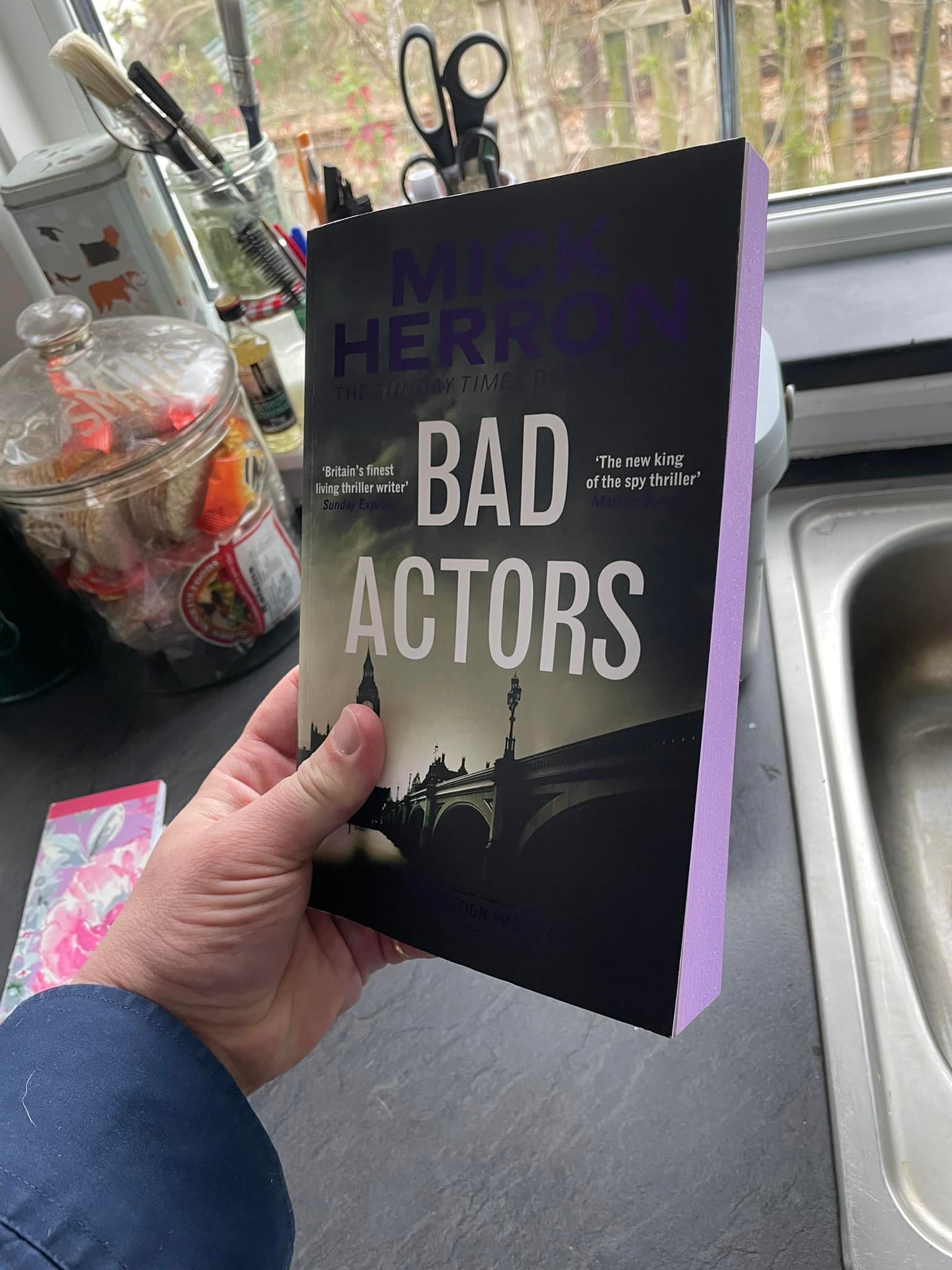
‘Bad Actors’ by Mick Herron

POLITICS IS A DANGEROUS GAME


In MI5 a scandal is brewing and there are bad actors everywhere.

A key member of a Downing Street think-tank has disappeared without a trace. Claude Whelan, one-time First Desk of MI5’s Regent’s Park, is tasked with tracking her down. But the trail leads straight back to Regent’s Park HQ itself, with its chief, Diana Taverner, as prime suspect. Meanwhile her Russian counterpart has unexpectedly shown up in London but has slipped under MI5’s radar.

Over at Slough House, the home for demoted and embittered spies, the slow horses are doing what they do best: adding a little bit of chaos to an already unstable situation.

In a world where lying, cheating and backstabbing is the norm, bad actors are bending the rules for their own gain. If the slow horses want to change the script, they’ll need to get their own act together before the final curtain. (Synopsis courtesy of Hachette)

Let’s be clear: Mick Herron is not the first writer to notice the similarities between actors and politicians. Indeed, the peerless Yes Prime Minister included this little interchange:

Sir Humphrey Appleby: You know what happens when politicians get into Number 10; they want to take their place on the world stage.

Sir Richard Wharton: People on stages are called actors. All they are required to do is look plausible, stay sober, and say the lines they’re given in the right order.

Appleby: Some of them try to make up their own lines.

Wharton: They don’t last long.

Now, regular readers of Herron would shudder if a phrase like “they don’t last long,” because few if any characters in his work do last long and the more beloved, the more in danger they are. You have been warned.

I suspect that the literati are coming for Herron. He’s just too good to be allowed to continue without snark and insults from lesser writers. Having a high budget adaptation of your work, one so faithful as to appear slavish, starring two of the best actors in the UK today (Gary Oldman, Kristin Scott-Thomas) as well as supporting characters played by top quality talent like Saskia Reeves and Samuel West?

No danger. The critics are sharpening their knives in the cheap seats.

For me, though, let them come. He can take it in the same way Lamb breaks limbs for sport. Herron is the best prose stylist working today, bar none. In fact, for me he’s funniest writer since the one and only master: PG Wodehouse. That’s the highest praise I can give and there’s no hyperbole in it. His greatest secret, of course, is that he is not a comic novelist. He’s a thriller writer with plots to enthral who just happens to have a sense of humour drier than badly made couscous and a pen as fluid as an oil slick.

Here, Herron is on sparkling form as ever. Tackling politicians in his oeuvre would, one might have expected legendary pantomime villain Peter Judd to the fore. Not so: here as the curtain rises it is the Dominic Cummings replacement, Anthony Sparrow, thrust into the spotlight.

This allows Herron to really break out the champagne lines:

“Sparrow wasn’t as high profile as his predecessor had been – it would have been challenging to maintain that level of unpopularity without barbecuing an infant on live television – but those in the know recognised him as a home-grown Napoleon: nasty, British and short.”

Also present is a cast of familiar household favourites. Claude Whelan returns to active duty, Diana Taverner, Roderick Ho, Lech Wicinski Catherine Standish, Louisa Guy are also all on the bill. And… is that… is that Shirley Dander in rehab like some form of Amy Winehouse record?

There’s even a cameo from a familiar face – but not one we’ve seen in the novels before. A perennial understudy forced onto the stage, if you will.

Then, of course, there is Jackson Lamb, the grotty gravitational force around which the entire Slough House orbits.

The devil may get all the best music, but the star turn gets all the best lines and boy-oh-boy does Lamb have yet another headline grabber here.

Covid exists in this world but I think it’s safe to say, Lamb is in fine form. Oh and terrorising Standish as ever like the one man culture war wrecking ball he is.

“She put the stool by the door; placed the sanitiser on top of it.

Lamb opened one eye. ‘Lubricant? Pretty optimistic for a staff meeting.’ He closed it again. ‘But I suppose it’ll give be a chance to swap these gender fluids I keep hearing about.’…

Lamb adopted a wounded pout. ‘What did I ever do to her?’

‘Broke her arm?’

‘She still on about that? Bloody snowflake.’”

Like all good playwrights, Herron likes structure to great effect; in fact aficionados of his work expect it. Here, the master uses structure even more than normal and the novel is no worse for that.

As the curtain closes, the reader is left with only some certain knowledge: Firstly, that Herron is the best in the business and long may his run continue when the quality is this high.

Secondly, that Apple TV+ really picked the right property to develop when they chose to let the Slow Horses out of the stable.

Purchase Links:

Amazon: https://www.amazon.co.uk/gp/search/ref=sr_adv_b/?field-isbn=9781529378702&tag=hachetteuk-21

Blackwell’s: https://blackwells.co.uk/bookshop/product/9781529378702

Book Depository (Free shipping to the US): https://www.bookdepository.com/Bad-Actors-Mick-Herron/9781529378719

Bookshop.org: https://uk.bookshop.org/a/10403/9781529378702

Foyle’s: https://www.foyles.co.uk/all?advsearch=1&isbn=9781529378702&aCode=AFW&awc=1414_1652294215_49841d552e93c65d33eb53ee0852e906

Author Bio

Mick Herron is a bestselling and award-winning novelist and short story writer, best known for his Slough House thrillers. The series has been adapted into a TV series starring Oscar-winning actor Gary Oldman as Jackson Lamb.

Raised in Newcastle upon Tyne, Herron studied English Literature at Oxford, where he continues to live. After some years writing poetry, he turned to fiction, and – despite a daily commute into London, where he worked as a sub editor – found time to write about 350 words a day. His first novel, Down Cemetery Road, was published in 2003. This was the start of Herron’s Zoë Boehm series, set in Oxford and featuring detective Zoë Boehm and civilian Sarah Tucker. The other books in the series are The Last Voice You Hear, Why We Die, and Smoke and Whispers, set in his native Newcastle. During the same period he wrote a number of short stories, many of which appeared in Ellery Queen’s Mystery Magazine.

In 2008, inspired by world events, Mick began writing the Slough House series, featuring MI5 agents who have been exiled from the mainstream for various offences. The first novel, Slow Horses, was published in 2010. Some years later, it was hailed by the Daily Telegraph as one of “the twenty greatest spy novels of all time”.

The Slough House novels have been published in 20 languages; have won both the CWA Steel and Gold daggers; have been shortlisted for the Theakstons Crime Novel of the Year four times; and have won Denmark’s Palle Rosenkrantz prize. Mick is also the author of the highly acclaimed novels Reconstruction, This is What Happened and Nobody Walks. (Biography courtesy of https://www.mickherron.com/landing-page/mick-herron-about)

You can read my previous reviews of some of Herron’s earlier novels, Slough House here and Joe Country here

For all things Mick Herron, there is no finer place on the internet than Jeff Quest’s Barbican Station. You can follow him on Twitter at www.twitter.com/spywrite