Slow Horses Still Glued Up

Slough House’ is dirty; ‘Spook Street’: deadly. Now we have the duplicity of ‘Joe Country’ – perhaps the next stop for Mick Herron’s ‘Slow Horses’ will be a devious ‘Intelligence Continent’?

As it is, ‘Joe Country’ is a fine addition to the series. Few writers can weave such deft description and pacy plotting – garnished with lashings of humour and even dashes of pathos – as Herron and each novel builds to a crescendo in which the reader is left feeling both traumatised and hungry for the next instalment.

There’s little doubt that Herron is a confident writer at the top of his game. This series has become famous for its openings: Dickensian wanders through locations in an omniscient voice quite unlike other writers working today. Here, he sheds this trope, instead opting for a reveal different to the structure of the other texts.

His confidence has also been apparent for a while in his wanton profligacy with his characters. It must take iron nerves for a writer to dispose of such well-rounded, independent characters brimming with such vim and spark as these Slow Horses. And yet, here again, Herron is prepared to dispose of them with abandon. As in the old TV series Spooks (MI:5 in the US), no one is safe and this means no reader can ever truly relax that their favourite character won’t end up at the knackers yard in the next ten pages.

Finally, there is Jackson Lamb. A Rabelaisian grotesque, becoming progressively more grotesque by the novel. And, in truth, Lamb is actually my biggest quibble of this first rate book. He dominates the proceedings so completely that you pine for his nastiness when he is off stage. This is Banquo as central character, relegating Macbeth to bit part player by sheer force of personality (or blackened toe wiggling through undarned sock, if you will).

There are a few minor worries deriving from Lamb which I hope are me being hyper critical. He keeps “appearing” and “vanishing” like an obese Paul Daniels – or a less creepy David Blaine – and I hope this doesn’t signal either Lamb as supernatural entity or that Herron is now so successful that he has entered the realm of the uneditable: too grand for repetitions to be noted and corrected. I think not on the whole.

Joe Country’ is proof, if any were needed, that Herron stands at the pinnacle of the espionage genre, (possibly snug on the heights with Jeremy Duns and Charles Cumming). Others have already noted it is not a book which would reward readers unfamiliar with the series but for all that, I hope the Slow Horses have many more races left to run.

In short: Horses far from in need of the knacker’s yard: 4/5*

  • Other details:
  • ISBN: 9781473660359
  • Publication date: 20 Jun 2019
  • Imprint: John Murray

Thanks to Netgalley for the advance copy

A Dance to the Music of Crime

I have an aunt who once told me in confidence that the greatest relief of her life was when she read an article explaining that she did not have to read Proust in order to be considered well read. She is, by any normal, sane standards, an exceedingly well read lady but no amount of madeleines and tea or epiphanies can persuade her that she wants to wade through the full text of A La Recherche du Temps PerduIn a House of Lies

As someone who is still struggling to chart the full course of ‘Swann’s Way’, I understand those readers who share her aversion when it comes to the writer regarded as the English Proust, Anthony Powell and his masterwork, ‘A Dance to the Music of Time. Interestingly, Ian Rankin does not appear to be one of them. In fact, he’s quite the fan.

I was a member of the Anthony Powell Society (I lapsed, I’m sorry! I’m coming back – promise!) but every year, I re-read the full 12 novel sequence (or, perhaps, re-listen is a more apt description as I listen to the mighty Simon Vance’s audiobook recording?)

This time, I had to bench this particular pleasure as I I was impatient to listen to the latest John Rebus outing – ‘Taggart’ actor James MacPherson having recorded all of the Rebus novels to date and done a superb job.

The_dance_to_the_music_of_time_c._1640

Nicholas Poussin’s Dance to the Music of Time

I’ve long believed that Rankin is foremost chronicler of contemporary Scottish life. From as far back as ‘Set in Darkness‘ which hinged upon – and poked fun at – the furore around the opening of the Scottish Parliament, it has long been obligatory to say that ‘Edinburgh is as much a character as the people’ (a compliment used so often it sets my teeth on edge, what it does to Rankin’s dentistry I can only imagine.)

But, for me, it always felt that it was ‘Naming of the Dead’ where Rankin really began to embrace parachuting Rebus and his Watson – boy she’d hate that – Siobhan Clarke like action hero Rosencrantz and Guildensterns charging through the 2005 G8 summit.

And then Rebus reached retirement age and that was that.

Except it wasn’t. Rankin managed the seemingly impossible. He brought our misanthrope hero back, he got to have the joy of seeing Clarke outrank her mentor and then he got to play fantasy comic book team up by including anti-Rebus goody two shoes, Malcolm Fox.

Rebus’ Moriarty, “Big Ger” Cafferty also lurched towards retirement although –spoiler alert – maybe not of the lasting variety. The Naming of the Dead

Last year, 30 years after he first beat the streets of our capital, a character now as unrecognisable as the city he is associated with, Rebus took a year off.

It was void in my reading life, for sure.

Hence my impatience to get hold of the big man’s 22ndouting. And then: somewhat unexpectedly, it was Powell that ‘In a House of Lies‘ reminded me of.

You could detail the plot: body in car in woods, old case reignited, Rebus on original investigation, the veteran doing a favour for Clarke who has been receiving threatening calls, but you know what? It’s not important (sorry Ian, I can only imagine how annoying it is after all your hard work) but I just like seeing the team back together.

I love Rebus bristling with Fox, walking his new sidekick Brillo, see him still driving his knackered Saab (“It’s not vintage, it’s old,” he testily informs another character at one point.) It’s comforting to spend time with Clarke.

For a reader, it’s like a warm bath – albeit one with murder, low budget Scottish film making and a distinctly tongue in cheek hat tip to the more cosmetic societal changes of the MeToo movement. Perhaps the greatest trick Rankin pulls off is introducing new characters like

The way characters move in and out of each other’s lives is Powell-esque, as are the coincidences. I wonder how the books play down south where I imagine having a detective who worked the original case and all the spiralling connections seems far-fetched. For those readers I say: come to the Highlands, it seems positively weird if you don’t run into colleagues all the time.

Nick Jenkins

James Purefoy as Nick Jenkins

So, can you directly compare Rebus world to the comic novels of upper middle class manners of ‘Dance’?

Course you can.

John Rebus as Nick Jenkins? I think not. Our hero is far too down to earth and interesting to play the arrogant first person protagonist of Powell’s world. But he (used to) drink enough to be classic soak Charles Stringham and is charming enough when he wants to be to get his own way with a passion for danger so, perhaps, he is the Peter
Templar of the sequence.

Siobhan Clarke is, I think, Emily Brightman. An esoteric pull, I admit, but this seemingly minor character has Clarke’s desire to cut through the flowery prose which obfuscates and frustrates clarity (see her demolition of the French gutter press in book 11 ‘Temporary Kings) which powers Siobhan.

Malcolm Fox is more tricky. He has elements of the Widmerpool about him in his difficult family life, his desire to be “good” (whatever that means in his world) but he also wants to be loyal and, across his immersion in the word of Rebus has become a far more interesting character than in his more staid standalone world. His seemingly magnetic romantic attraction brings to mind Ralph Barnby, although a Byronic Lothario painter is about as far from Malcolm as could be imagined, so a hybrid Widmerpool, Barnby and civil servant Sir Leonard Short is possibly convincing, even if the mind boggles. Widmerpool

And so what of Big Ger Widmerpool then? He has waltzed in and out of the dance of Rebus’ life for nigh on 30 years and, even though pretenders to the throne like Daryl Christie are strong characters, even the best of these never quite move past Pepsi to the big man’s full fat Coke.

That’s why this is where the comparison breaks down. Powell never wrote anyone like the Gothic Cafferty. He’s more like John Le Carre’s Karla, locked in intellectual combat with his nemesis, as Rebus’ dance card fills and people come and go.

smileypeoplekarla.png

Patrick Stewart as the reticent espionage genius Karla.

Powell’s 12 novel sequence is, arguably, the finest long form work in English. Certainly, as roman fleuve go, it is accessible, amusing and poigniant.

But what Rankin has achieved is truly remarkable. If it was “literary fiction”, whatever that is, it might get treated with less snobbery but for a razor sharp analysis of the monumental changes which have taken place in the last 30 years in Scotland, this is as fine writing as you could ask for. Funny, sharply observed, moving, pacey and rooted in a world recognisable to ordinary folk. And he’s done that over 22 novels (in this sequence alone).

61wMZQZ69PL._SX496_BO1,204,203,200_In a 2015 piece about ‘Even Dogs in the Wild‘, I suggested that Rankin was getting better and better. On this evidence, and unlike the unholy trinity of Rebus, Clarke and Fox, I may have understated the case.

‘In A House of Lies’ Ian Rankin, Orion, 4thOctober, 2018, ISBN-10 9781409176886


Mister Brunetti and the things that he is not

Is it really 23 years since first we  met? Who could not love Commisario Guido Brunetti and his loveable collection of family and colleagues?

Venice – it is traditional at this point to say that the city is as much a character in the novels as the humans,  – the city Brunetti navigates with as much detached san froid as he can muster as the murky world of Italian police work intrudes on his homelife.

Falling in love

Donna Leon’s 24th addition to the Brunetti series is Falling in Love

There are many theories as to why people read crime fiction – catharsis born of frustration at their own lives, vicarious wish-fulfillment to name but two – but there’s no doubt that Donna Leon’s characters buck the trend of the standard tropes found in the genre.

So much so, that to define the character of Brunetti, it may be easier to say what he is not.

Brunetti is not divorced. Married to a wonderful professor of literature, Paola. She may have been born into the Venetian nobility, but this rebellious left wing academic with a burning – necessarily unrequited – love of Henry James is mother to his children and always on hand to tease him, gently chide or act as a moral arbiter for Guido if he begins to stray too far from the path of righteousness. Paola can cause him problems, such as when, in fury at the authority’s lack of power to counter a sex tourism travel agency, she was driven to smashing the firm’s window with a brick, but she is almost always on hand to provide a sumptuous home cooked lunch or dinner.

Brunetti is not an alcoholic. Although, he is partial to a little tipple on his terrace at the end of a long day. Or lunch time. Or whenever the Veneziano weather will allow.

Brunetti is not fetishistic about the law.  As a Commisario of the Italian police, Brunetti is most often found examining his cases in terms of real politik – can something be done? If so, at what cost? And, how many favours will it cost a good man? If the answer to any of these is too much; then he may well let things slide. But never too far – after all, he still has to face Paola at the end of the day.

Brunetti is not estranged from his family. He has too children, Raffi and Chiara. They have not aged a great deal over the preceding near-quarter of a century, Raffi is a perpetual teen at university and still coming home to Mama, whilst Chiara has inherited his mother’s social conscience, but both children will still do the washing up after a family meal – even with a little grumbling.

Brunetti is not a lone wolf, or vigilante against the world. Guido relies heavily on a support network of colleagues, most notably his sergeant (later Ispettore) and friend Vianello, who plays Horatio to his Hamlet.

His greatest asset in his work – at least in terms of getting results – is the mysterious Signorina Elettra. His boss Vice-Questore Patta’s secretary, well connected and with a varied dating history, she spends the finances of the Questura on flowers to brighten her day and spends the rest of the time frightening Patta with her intelligence and Brunetti with her ability to circumnavigate the computer systems of the Italian state. Oh and the law, but she never seems to worry too much about that.

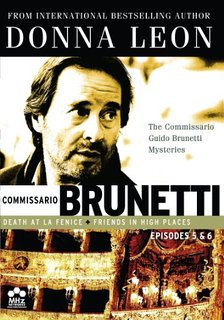
Brunetti

Some of the Brunetti books were adapted fro German television, apparently to Leon’s displeasure.

On the other hand, Brunetti is in conflict with his boss. One trope of the genre Guido does fit is his dislike of his boss. Vice-Questore Patta is vain, lazy and southern. Not a great combination in Brunetti’s opinion. He is joined by his subordinate brought along from Naples in the unlovely form of Lieutenant Scarpa who, over the course of the novels, has done nothing but snarl and act as a counter-weight to Brunetti and Vianello’s innate goodness.

Across a series this long, there is some variation in quality, for sure. The earliest novel, Death La Fenice was a promising start, but the series really hit its stride with a run that took Brunetti from a military academy in Uniform Justice to the famous glass works on Murano in Through a Glass Darkly.

Latterly, the novels feel like they have fallen into a comfy rhythm that pleases rather than pulsates on the reader’s palate. The latest novel, Falling in Love, is the 24th in the series and brings us back full circle to the opening opera-themed novel. And it’s fine. Not the best, not the worst.

But, if you’ve never had the pleasure of meeting the Brunettis, dip in. You’ll not be sorry.

Falling in Love is available from Amazon.co.uk

‘Gironimo’ by Tim Moore

Girnomino

I read Tim Moore’s book, ‘French Revolutions’ when it came out 10 years ago and liked it. In the book, Moore details his attempts to cycle the route of the Tour de France on his own in his ill-prepared fashion, with a charmingly wry wit.

I liked it, I think, because I like travel books and I like travel, and manage to do so as regularly as I can, always in a wry and ill-prepared fashion and without any of the insouciance and sang froid that I would like to imagine that I possess. So, I liked his work. But I didn’t remember it as especially memorable and I’d lost track of his work subsequently.

I picked up this book for a friend’s birthday gift. A thought process no more complex than; ‘he likes cycling and we both love Italy. What could go wrong?’

This time, Tim Moore cycles the route of a race, on his own, recording his observations about his lack of preparation in a charmingly wry fashion. Seeing a pattern here?

In this case, he retraces the route of the 1914 Giro d’Italia, known as one of the most difficult races in cycling history. A nice addition is that this time he decides to undertake this madcap scheme on a reconditioned original – or as original as can be sourced – century old bicycle and dons woollen riding kit to boot.

And, here’s the thing: I loved it. It is one of the most genuinely laugh out loud books I’ve read, ever. I was not prepared for the sheer range of laughs the writing provoked, ranging from childish sniggers as he brakes and catapults his genitals onto the exposed rusted bolt where the front of his saddle should be, to the screamingly funny story of the cyclist who had enough in the original race and proceeded to savagely beat an unfortunately officious customs official who got in the way.

Moore manages to convey all of this with grace and no little use of simile. “‘To ride is to work,’ I said to my knees. ‘Each turn of the pedals is like the click of the freelance writer’s mouse’ or “‘It was as if my intimate parts now belonged to someone else: someone who was dead, and had died a virgin.’”

There are lags in the book, for sure. Any travel book will, at some stage, encounter the problem that, after a while, the writer must move and conveying regular movement – unless something extreme is happening – can be quite dull.

Moore’s solution when he doesn’t have a homemade wine bottle cork brake block repair anecdote to convey is two-fold. He either simply dips into the official history of the original tour and finds another tale of riders falling asleep in barns from hypothermia or drinking red wine from their panniers or keeps track of his own progress along the course against the times and distances of the original riders.

This book is a triumph of the genre and fully deserved its place on the Radio 4 Book of the Week list. It is so good I’m off to re-read ‘French Revolutions’ to check that I didn’t miss something a decade ago.

Moore is an approachable guide and its light, amusing, tone is the perfect complement to the guilt that comes from reading about someone else’s adventures while you’re slobbing at home.

I’m glad there are men out there prepared to do things to push themselves physically to the limits. I’m glad it’s not me that has to and I’m especially glad when they have Tim Moore’s ability to document these feats of ill-prepared carnage in charmingly wry observations.

Gironimo! in Five Words: Laughing to the Finish Line

You can follow the author on Twitter @MrTimMoore and the publishers, Yellow Jersey Press @YellowJersey_ed