Strength Through Fragility

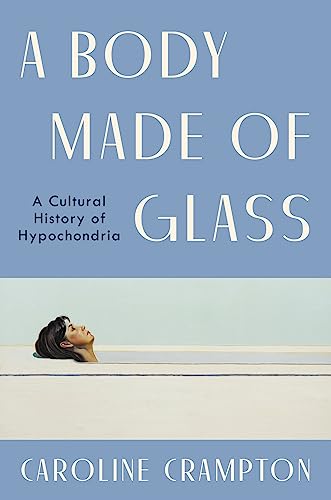
A Body Made of Glass by Caroline Crampton
How often does one read something which, within the first page, makes you wholly reconsider your stance on something?

I don’t mind admitting, hypochondria is not something to which I had really given a lot of thought. Or, any thought really. Now, I understand that this itself is a form of privilege – a freedom to not have worried about my health in any meaningful way, should not be taken for granted.

But if I had been given cause to pause and define hypochondria, I suspect I would have considered it… “a fear of illness entirely psychosomatic,” (a concept, and word, I know solely thanks to The Prodigy. Who says music teaches nothing?)

And yet, on page one of Caroline Crampton’s latest book, A Body Made of Glass, we are told of the teen cancer which, in essence, derailed her later teen years and triggers a long-term struggle with the condition of hypochondria.

Which seems… reasonable? It had never occurred to me that hypochondria might be based upon a rational foundation. To have been diagnosed, and then survived, what can only be described as a trauma, and to then imagine that every twinge may be the beginning of another setback on the road to full, sustained health, begins to look like a logical belief structure.

Crampton herself examines this in her own inimitable style. “The body has what has been described as ‘a limited vocabulary of subjective sensations’. I may think that I can feel things growing inside me that shouldn’t be there, like roots creeping unseen through the soil, but there is no evidence to suggest that this is actually the case.”

Creepily effective pastoral metaphor aside, the reader can’t help but think, “Yeah! How could you not!?”

Once you get up to speed with this concept, the slippery and transitional nature of the condition comes into view. What follows is fascinating as Crampton embarks on a multi-millennium tour of the way that medicine has approached the unknown – and unknowable – nature of medicine.

Spoiler alert – women seem to get the fuzzy end of the lollipop. Repeatedly.

I know Crampton best from her work on Golden Age of Crime podcast, Sheddunnit. She is an engaging and accessible doyen of that particular manor and her erudite, spectacularly widely read knowledge of the genre pervades that particular domain.

But it is nothing compared to the interdisciplinary tour de force which A Body Made of Glass presents to the reader. From ancient Egypt, via Plato, Peter Griffin and South Park, this is a whip smart journey through cultural reference points of high brow, pop and low brow culture.

Frankly I am exhausted by the thought of her reading list, let alone the writing of the text which followed.

Interspersed through these cultural touchstones are anecdotes, personal, observational – what I have come to regard as the “jar of pee” episode is one I see attracting attention in other reviews – but I was rather fond of the family she encounters at a hotel breakfast room who express their familial affection by recounting in lavish detail their bowel movements as they break their fast. Personally, I’d have recounted my own food at projectile velocity over them as a reward for this particular start to my morning but CC is a lot nicer than I am.

Crampton includes an excellent section of Robert Burton’s Anatomy of Melancholy, a text a favourite author of mine, Anthony Powell, leans heavily on in the later volumes of A Dance to the Music of Time. In the same way as Nick, the narrator of the series, says, “became rather hard not to see Burton in everything,” one feels Crampton has been living her life seeing hypochondria and its “’infinite varieties,’ Burton said,” in every book she has read, television show she has watched, every play she has seen.

She quotes Burton further when she recounts him writing, “the tower of Babel never yielded such confusion of tongues, as the chaos of melancholy doth variety of symptoms.’” Her corollary to this, that, “reading Burton, one comes away with the dizzying feeling that melancholy is everything and everything is melancholy,” is rather how the reader leaves the text feeling. Is hypochondria everything and everything hypochondria?

Does Crampton manage to move on and improve her trauma informed response to her childhood illness and the fruits of this poisoned tree it left her?

Well, that would be as bad as giving away the killer on page two of a Golden Age detective novel. Suffice to say, in a writer as warmly welcoming in her accomplished prose, as well as being as erudite and engaging as Caroline Crampton, you will just be happy to be along for the tour.

Author Bio

Caroline Crampton is a writer and podcaster. She writes non-fiction books about the world and how we live in it — The Way to the Sea (2019) and A Body Made of Glass. She makes a podcast about detective fiction called Shedunnit, she curates articles for The Browser, and reviews and essays for publications like Grantathe New Humanist, the Guardian and the Spectator. (Biography and photograph adapted from https://carolinecrampton.com/)

Purchase Links:

https://geni.us/aK99kec

A Dance to the Music of Crime

I have an aunt who once told me in confidence that the greatest relief of her life was when she read an article explaining that she did not have to read Proust in order to be considered well read. She is, by any normal, sane standards, an exceedingly well read lady but no amount of madeleines and tea or epiphanies can persuade her that she wants to wade through the full text of A La Recherche du Temps PerduIn a House of Lies

As someone who is still struggling to chart the full course of ‘Swann’s Way’, I understand those readers who share her aversion when it comes to the writer regarded as the English Proust, Anthony Powell and his masterwork, ‘A Dance to the Music of Time. Interestingly, Ian Rankin does not appear to be one of them. In fact, he’s quite the fan.

I was a member of the Anthony Powell Society (I lapsed, I’m sorry! I’m coming back – promise!) but every year, I re-read the full 12 novel sequence (or, perhaps, re-listen is a more apt description as I listen to the mighty Simon Vance’s audiobook recording?)

This time, I had to bench this particular pleasure as I I was impatient to listen to the latest John Rebus outing – ‘Taggart’ actor James MacPherson having recorded all of the Rebus novels to date and done a superb job.

The_dance_to_the_music_of_time_c._1640

Nicholas Poussin’s Dance to the Music of Time

I’ve long believed that Rankin is foremost chronicler of contemporary Scottish life. From as far back as ‘Set in Darkness‘ which hinged upon – and poked fun at – the furore around the opening of the Scottish Parliament, it has long been obligatory to say that ‘Edinburgh is as much a character as the people’ (a compliment used so often it sets my teeth on edge, what it does to Rankin’s dentistry I can only imagine.)

But, for me, it always felt that it was ‘Naming of the Dead’ where Rankin really began to embrace parachuting Rebus and his Watson – boy she’d hate that – Siobhan Clarke like action hero Rosencrantz and Guildensterns charging through the 2005 G8 summit.

And then Rebus reached retirement age and that was that.

Except it wasn’t. Rankin managed the seemingly impossible. He brought our misanthrope hero back, he got to have the joy of seeing Clarke outrank her mentor and then he got to play fantasy comic book team up by including anti-Rebus goody two shoes, Malcolm Fox.

Rebus’ Moriarty, “Big Ger” Cafferty also lurched towards retirement although –spoiler alert – maybe not of the lasting variety. The Naming of the Dead

Last year, 30 years after he first beat the streets of our capital, a character now as unrecognisable as the city he is associated with, Rebus took a year off.

It was void in my reading life, for sure.

Hence my impatience to get hold of the big man’s 22ndouting. And then: somewhat unexpectedly, it was Powell that ‘In a House of Lies‘ reminded me of.

You could detail the plot: body in car in woods, old case reignited, Rebus on original investigation, the veteran doing a favour for Clarke who has been receiving threatening calls, but you know what? It’s not important (sorry Ian, I can only imagine how annoying it is after all your hard work) but I just like seeing the team back together.

I love Rebus bristling with Fox, walking his new sidekick Brillo, see him still driving his knackered Saab (“It’s not vintage, it’s old,” he testily informs another character at one point.) It’s comforting to spend time with Clarke.

For a reader, it’s like a warm bath – albeit one with murder, low budget Scottish film making and a distinctly tongue in cheek hat tip to the more cosmetic societal changes of the MeToo movement. Perhaps the greatest trick Rankin pulls off is introducing new characters like

The way characters move in and out of each other’s lives is Powell-esque, as are the coincidences. I wonder how the books play down south where I imagine having a detective who worked the original case and all the spiralling connections seems far-fetched. For those readers I say: come to the Highlands, it seems positively weird if you don’t run into colleagues all the time.

Nick Jenkins

James Purefoy as Nick Jenkins

So, can you directly compare Rebus world to the comic novels of upper middle class manners of ‘Dance’?

Course you can.

John Rebus as Nick Jenkins? I think not. Our hero is far too down to earth and interesting to play the arrogant first person protagonist of Powell’s world. But he (used to) drink enough to be classic soak Charles Stringham and is charming enough when he wants to be to get his own way with a passion for danger so, perhaps, he is the Peter
Templar of the sequence.

Siobhan Clarke is, I think, Emily Brightman. An esoteric pull, I admit, but this seemingly minor character has Clarke’s desire to cut through the flowery prose which obfuscates and frustrates clarity (see her demolition of the French gutter press in book 11 ‘Temporary Kings) which powers Siobhan.

Malcolm Fox is more tricky. He has elements of the Widmerpool about him in his difficult family life, his desire to be “good” (whatever that means in his world) but he also wants to be loyal and, across his immersion in the word of Rebus has become a far more interesting character than in his more staid standalone world. His seemingly magnetic romantic attraction brings to mind Ralph Barnby, although a Byronic Lothario painter is about as far from Malcolm as could be imagined, so a hybrid Widmerpool, Barnby and civil servant Sir Leonard Short is possibly convincing, even if the mind boggles. Widmerpool

And so what of Big Ger Widmerpool then? He has waltzed in and out of the dance of Rebus’ life for nigh on 30 years and, even though pretenders to the throne like Daryl Christie are strong characters, even the best of these never quite move past Pepsi to the big man’s full fat Coke.

That’s why this is where the comparison breaks down. Powell never wrote anyone like the Gothic Cafferty. He’s more like John Le Carre’s Karla, locked in intellectual combat with his nemesis, as Rebus’ dance card fills and people come and go.

smileypeoplekarla.png

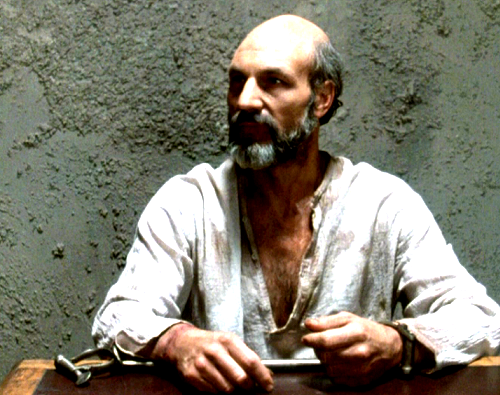
Patrick Stewart as the reticent espionage genius Karla.

Powell’s 12 novel sequence is, arguably, the finest long form work in English. Certainly, as roman fleuve go, it is accessible, amusing and poigniant.

But what Rankin has achieved is truly remarkable. If it was “literary fiction”, whatever that is, it might get treated with less snobbery but for a razor sharp analysis of the monumental changes which have taken place in the last 30 years in Scotland, this is as fine writing as you could ask for. Funny, sharply observed, moving, pacey and rooted in a world recognisable to ordinary folk. And he’s done that over 22 novels (in this sequence alone).

61wMZQZ69PL._SX496_BO1,204,203,200_In a 2015 piece about ‘Even Dogs in the Wild‘, I suggested that Rankin was getting better and better. On this evidence, and unlike the unholy trinity of Rebus, Clarke and Fox, I may have understated the case.

‘In A House of Lies’ Ian Rankin, Orion, 4thOctober, 2018, ISBN-10 9781409176886