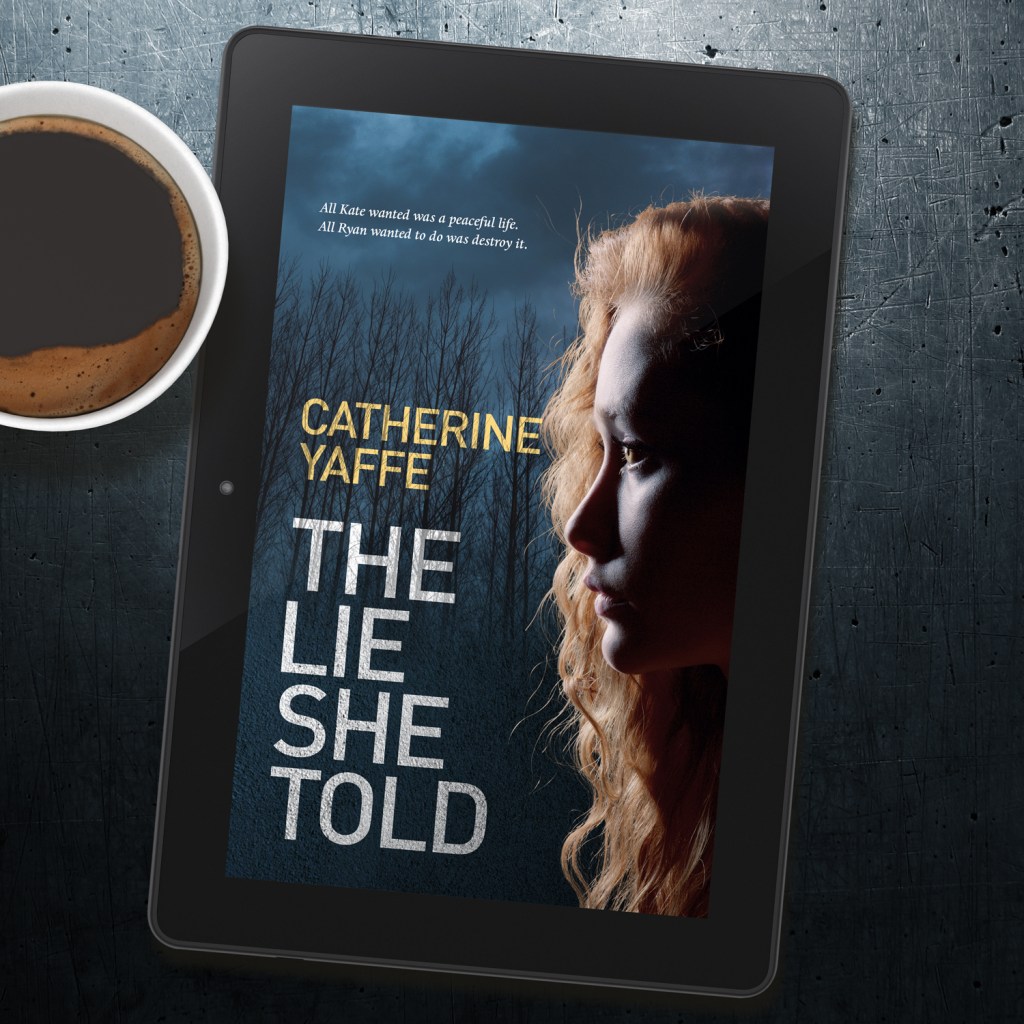
Courtesy of Catherine Yaffe, PAJNewman is delighted to be able to bring you an exclusive extract of The Lie She Told – You can read a review of the novel here
All Kate wanted was a peaceful life.
All Ryan wanted to do was destroy it.
Kate and her son Joe have created a new life for themselves in the Highlands of Scotland and she couldn’t be happier. That is until she picks a stranger up from the side of the road that turns out to be a figure from her past. Will all her secrets be revealed?
“Ryan?” She asked, risking a glance sideways
“Haha, I wondered when it would dawn on you”
“What the hell..how..” Kate was speechless. She’d last seen Ryan on the final day of the court hearing, hanging around outside on the court steps. As memories slowly clicked into place she went through a series of emotions. Her hands started to shake, heart pounding she moved from recognition to anger in a split second.
She swerved violently and pulled haphazardly onto the side of the road.
“What the actual? What are you doing here?” she removed her seatbelt and despite the lashing rain opened the car door and got out.
“Get out of my car now!” she yelled above the cacophony noise that swirled around the hills of the Highlands.
Ryan leaned over into the driver seat and shouted something, but Kate could only see red as rage, shock and fear took over.
“I want you out of my car now!” she screamed again, shaking with anger.
Reluctantly Ryan did as she demanded and stepped into the monsoon,
“Kate, come on, don’t be like that”, he headed around the front of the car towards her.
She backed away,
“Oh no you don’t, stay away from me Ryan”
Ryan carried on forward, relentless, “Kate, what’s wrong with you?”
“Stop it Ryan, I don’t have to listen to anyone, anymore. I am not the same naive victim that you knew back then, and I will not listen to your bullshit”
Catherine Yaffe is a former freelance journalist, magazine editor and digital marketing agency owner. Catherine has previously written non-fiction books on Digital Marketing before following her passion for writing crime novels full time.
The Lie She Told is the first in a series of books that challenge the status quo of relationships and makes the reader question how well you know those around you.
Catherine lives in West Yorkshire with her husband Mark and their 2 cats Jenson & Button (she’s also a F1 fan!)
‘The Lie She Told’ by Catherine Yaffe: Encouraging debut from a clearly talented writer takes us to the misty, murky motivations in the world of Scotland’s West Coast.
You can read an exclusive extract of the novel here:
All Kate wanted was a peaceful life.
All Ryan wanted to do was destroy it.
Living in the remote Scottish Highlands under Witness Protection, life is finally happy for Kate Ward and her young son Joe, until someone from Kate’s past appears. Ryan Albright is the only person that knows all of Kate’s secrets, and what she had to do to escape her previous abusive relationship. Ryan is determined to complete the mission set for him by Kate’s ex-husband. Systematically and violently, he pulls Kate’s new world apart with devasting consequences for everyone around him, including Kate who must face up to the lie she told.
There’s been quite the West Coast Scottish crime theme developing on this blog over the last few weeks. Recently we had Alex Coombs and his Argyll-based Private Investigator Hanlon taking on drug lords and layabouts and this week we have a murky crime drama set a touch further north in Gairloch.
Catherine Yaffe’s debut The Lie She Told is a very different type of novel to Coombs’ offering, however. Instead of a teak hard heroine able to take blows to the face and bounce back to care for her dog, here we have Kate, a mother of a young son, relocated as part of the witness protection scheme to the village of Gairloch.
As a resident of the Highlands, I can tell you: this sort of thing does happen. What this novel, perhaps, does not really capture, is that most of the Highland communities know about it before the people even arrive, but that might have spoilt the broiling tension somewhat.
Instead, we have Kate meeting up – coincidentally – with Ryan: a local no-gooder who Kate knew well in her days in Leeds and who was, in fact, best friends with her abusive ex-husband.
Tensions rise for the reader as the dastardly, manipulative Ryan ensnares the too-trusting Kate in a web of deceit.
However, few people in this novel are quite what they seem and motivations are as grey and murky as an autumn day in Gairloch.
This is a psychological thriller which manages the powerful balance of nipping along at pace but also lingering in the reader’s minds. There’s little wham bam here – action often occurs off screen (as it were) – and wounds physical and emotional, fester and turn sour.
It is a very competent debut by Catherine Yaffe. It is true that some of the dialogue can be occasionally laboured but this is a small niggle in such a psychologically complicated novel which doesn’t shy away from the pain that violence and it’s consequences causes.
I look forward to watching Yaffe’s career with interest with interest.
Catherine Yaffe is a former freelance journalist, magazine editor and digital marketing agency owner. Catherine has previously written non-fiction books on Digital Marketing before following her passion for writing crime novels full time.
‘The Lie She Told’ is the first in a series of books that challenge the status quo of relationships and makes the reader question how well you know those around you.
Catherine lives in West Yorkshire with her husband Mark and their 2 cats Jenson & Button (she’s also a F1 fan!)
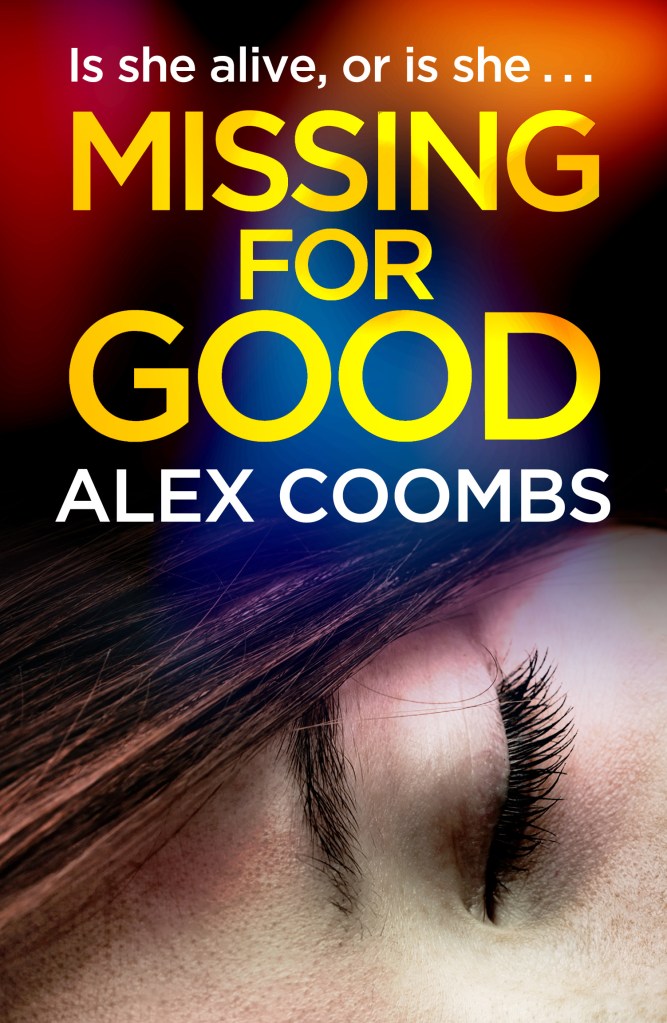
When the estranged daughter of Scotland’s premier art dealer goes missing, Private Investigator Hanlon is hired to find out where Aurora is.
But what she thinks will be a relatively straightforward job, soon turns dangerous. The missing girl has a troubled past but what made Aurora suddenly pack her bags and disappear?
Hanlon has her work cut out for her. The stakes are rising and she needs to get to the bottom of the case before someone else is attacked.
And is Aurora still alive, or is she missing for good?
A former detective in the Met, Hanlon now finds herself living in splendid isolation in the wilds of Argyll with just her knackered Vauxhall Corsa and her trusty hound Weymss to keep her company.
I wasn’t familiar with the work of Alex Coombs but the setting of Scotland was the thing which tickled my fancy. I live locally to the setting, I like a good Tartan Noir: colour me intrigued.
And Coombs did intrigue. Hanlon is a smashing character: damaged and haunted; loving her dog, her only emotional attachment; adjusting to her new rural life.
The University of Edinburgh alumni renders some parts of Scotland well – he’s good on the capital and its various sub-districts, as well as describing those single track roads which wind their way down towards the hamlets and villages on the road to Campbelltown.
There are some odd lapses – Loch Lomand in the Highlands? – but actually that’s the sort of mistake which seems to fit with the characters’ perspectives which is nice.
Coombs also has a mind for engaging characters – coke-addicted, psychotic Glaswegian hard men aren’t exactly original, but his is a memorable specimen of the species.
His gay hitmen are refreshingly rendered also and he has a lovely turn of descriptive phrase. “‘One person, they get in the van with the girl. Two people…’ He shook his head irritably. He was tired of this. There could be endless permutations – what if she arrived riding a camel? ‘Fuck it, if there’s two or more with her, we dinnae do anything.’”
He is no less comfortable skewering the pretentions of the Edinburgh students Hanlon encounters. “Morag was studying Creative Writing; if anyone was likely to make a mountain out of a molehill it was probably an aspiring writer with an overactive imagination.”
And this equally applies to the lecturers, “‘Look, I am an Artist!’ his dress proclaimed. Hanlon thought it also proclaimed, ‘Look, I’m an arsehole’ but for now she would keep that to herself.”
There are some false notes in the dialogue, occasionally it sounds a little generic and not specific to individual characters and there can be that flaw of the crime novel – a lot of recapping of plot while the detective muses to herself. Hanlon is a loner – having only a dog does limit her opportunity for natural sounding exposition.
However, ‘Missing for Good’ is a rattling good read, sprinting along with enjoyable gusto and building to a satisfying crescendo. All in all, thoroughly recommended – I’ll have to go back and read Mr Coomb’s other stuff now.
Author Bio – Alex Coombs studied Arabic at Oxford and Edinburgh Universities and went on to work in adult education before retraining to be a chef. He has written four well-reviewed crime novels as Alex Howard.
‘It got better, in time, though to be truthful it always felt more of a duty than a pleasure: a little like homework, satisfying when over, and done well, but never exactly enjoyable. But then nobody had ever suggested it could be otherwise.’
This was the view of Claudia Faraday, 1920s respectable wife and mother of three, on the subject of sex. That is until an unexpected turn of events shakes her out of her torpor and propels her back into the world revitalised and reawakened, where she discovers, as Marie Stopes might have said: Approached in the right way, even homework can be fun.
The cover of The Awakening of Claudia Faraday by Patsy Trench
The Awakening of Claudia Faraday is a delightful little novel which consistently confounds expectations. The cover, with its silhouetted protagonist could be for a new spy series, the pink writing could signal traditional “chick lit” (urgh – what a bind of a brand that is), the “Roaring Twenties” strap line makes it sound like a PG Wodehouse romp and the blurb description could be anything from a Jilly Cooper bonkbuster to a serious and measured study of the sexual awakening of upper middle class women in the early part of last century.
And, in the end, this rather sad, rather charming novel is a little of all of these things, (although spy thriller is a stretch. The only revelations here are of the human heart and mind, it is a little lacking in unmasked super villains to be fair.
Penetrating Pathos
It is sad. This is a quite and understated sadness of withering dreams and slipping youth. Claudia is a lovely protagonist. A gentle and well intentioned woman who, in her sixth decade, is only beginning to question her wants and desires.
Trench writes with such a penetrating pathos of the boredom of a newly empty nest that the reader’s heart aches for our heroine, so used is she to being of service to others that she is not even the lead character in her own story.
“And so the weeks passed, September into October, and no omnipotent author stepped in to liven up the shapeless plot that was Claudia’s life. She was back to counting the creaks as she ascended the stairs on her way to her bedroom.”
I spent a huge amount of time in the novel feeling desperately sad for Claudia. The Twenties were in distinct danger of not only failing to roar for her but also to go out with barely so much as a whimper.
It was clear that not only sex, but also any agency had been ground out of the character: by society; by men; by her friends; by her mother. This fundamentally sweet woman hadn’t noticed the hypocrisy of everyone else and so was facing the outgoing sands of time in baffled and barely articulated sorrow.
Charming Oddities
This gentle gloom is alleviated by the light touch, page turning writing skill and the assortment of charming oddities which surround her.
The loyal housemaid Lily – fairly consistently having to let her hand fly to her mouth after yet another misplaced observation of her mistress – is a cutie, old friend and occasional sparring partner Prue, seems to be made up of equal parts scandalous affairs in hot climates and terrible driving.
The absentee husband Gerald sounds what used to be called a perfect pill. Having ruined sex for her, then impregnated her three times scooting off overseas for archaeological digs, he could only make it to one of their children’s weddings.
The children themselves add colour and charm to the rather drab world of their mother. Jessica has a horsey laugh, a disordered house and is a flapper with a jolly husband with an alliterative name; Harriet is a Bohemian with a penchant for interior design and a wayward husband while the youngest daughter, Flora is all horse breeding and country air.
It is not a difficulty to spend time in the world of these delightful characters. It is especially easy when Claudia is making her slightly waspish observations such as:
“It was invariably the revolutionaries who managed to consume most of other people’s wine, and their food, while looking down on them from some lofty moral plinth upon which they had placed themselves.”
In conclusion, The Awakening of Claudia Faraday is a nice little novel filled with excellent characters, charming locations and the quiet desperation of some of our fellow citizens. I can’t wait to meet up with them again.
Patsy Trench lives a quiet and largely respectable life in north London. Claudia’s story shows a side of her normally shy and reserved nature that is little known, even to her friends and acquaintances. Her previous books, about her family’s history in Australia, are entertaining and informative accounts of that country’s early colonial beginnings. She began writing late, and in a previous life she was an actress, scriptwriter, playscout, founder of The Children’s Musical Theatre of London and lyricist. When not writing books she emerges from her shell to teach theatre and organise theatre trips for overseas students. She is the grateful mother of two clever and grown-up children, and she is addicted to rag rugging and, when current circumstances permit, fossicking on the Thames foreshore for ancient treasure.
I have always loved Nick Hornby. I fell in love with his prose when Fever Pitch came out and was suitably skewered by his analysis of insecure, introspective young men with High Fidelity. I was, of course, charmed by About a Boy.
And, although I feel like these are going to the three books on his tombstone, even his less well known/popular books are, at worst, always readable.
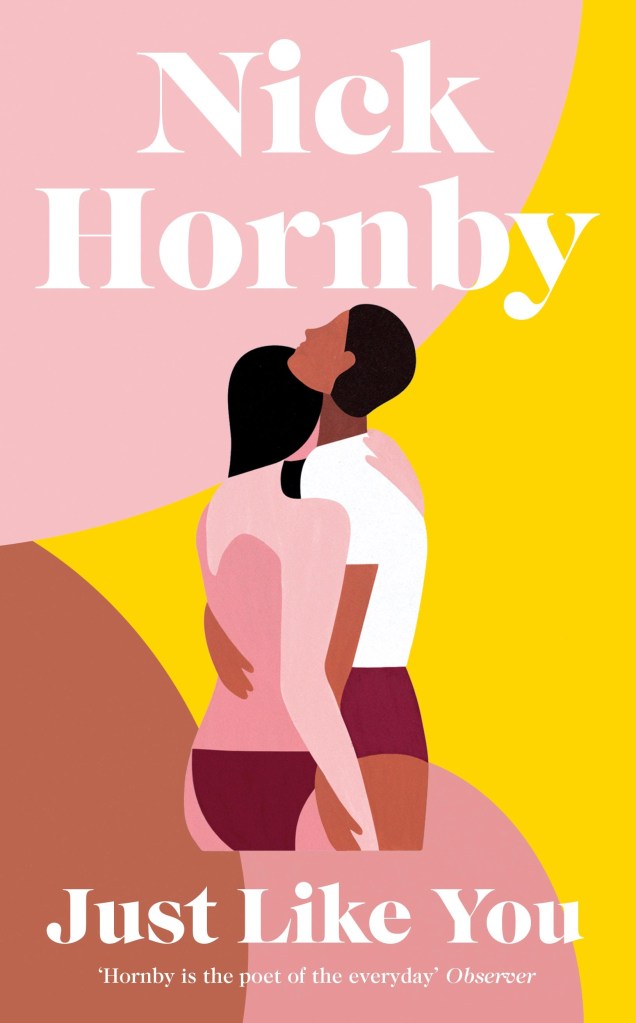
The cover of ‘Just Like You’ by Nick Hornby
Love Across the Brexit Barricades
I can’t quite decide if this book is going to get him in trouble or not. It certainly tap dances into some pretty heated areas: this is a novel of love across Brexit barricades, splintering society, race. Not too many hot button issues for a white, middle class writer of a certain age to try and tackle.
Except it isn’t really. Because it’s Hornby and he’s just so good at what he does. In Joseph and Lucy he seems to have the only two people in the world prepared to admit that they don’t understand issues and don’t have all, or indeed any, of the answers.
Plot Summary
Lucy is a divorcee in her early 40s with two kids. Head of English at a not particularly good north London comprehensive, she juggles a trying-to-reform alcoholic ex, a good group of friends and some fairly shambolic blind dates with good humour and a resignation that this might be what life has left in store for her.
Into this fairly acceptable world comes Joseph. A 22-year-old man who dreams of a making music while paying for himself through football coaching, a part time job in a leisure centre, a bit of babysitting and tutoring and a Saturday job in the butchers of Lucy’s gentrified area.
With the Brexit referendum looming in the background, these two magnetically attracted people must decide where they stand and whether their race, their income, their education and their very different worlds can be surmounted by love.
Fragmentation
What the novel definitely does do is a fantastic job of demonstrating the divisions within which our society works now.
Joseph and Lucy inhabit different worlds, by dint of race, age and income but – crucially – the flow of information is literally different.
Joseph gets his information from Instagram, chasing rabbit holes of information inaccessible to Lucy.
However, her white, middle class privilege means that both characters are ensconced in their own unintentionally echo chambers. If not comfortably then at least unquestioningly for a big chunk of the novel.
Hornby’s description of Lucy’s awareness of the difference between her generation is very well done and, frankly, scalpel sharp:
“Lucy was beginning to suspect that he might be what the girls at her school would refer to as a ‘fuckboy’, a word she discouraged them from using because of its first four letters but which in all other ways seemed an entirely welcome neologism. There had always been tarts and slags and sluts, and now there were fuckboys, and the contempt with which the girls spat the word out gladdened her heart.”
Astonishing Achievements
And yet, possibly its most astonishing achievements as a piece of work devoted to the present is that this is a novel from which anger is absent for the most part.
In fact, possibly the weakest aspect for the reader is that Hornby chooses not to show the arguments even when they do happen. They are reported but we don’t hear the words, we are merely told the fall out and left to decide for ourselves.
For a novel in which race is an enormous factor and at this moment in history, that’s a phenomenal achievement.
Hornby is still the best and most accessible of modern observers. He is razor sharp on the gentrified areas of north London where one normally encounters his characters.
There’s a definite lineage between High Fidelity’s Rob and his DJ ambitions and 22-year-old Jospeh and his tracks. Of course, whereas Rob ran a slightly dilapidated record shop which his partner was a corporate lawyer, here we have a partner who is Head of English at a bog standard comprehensive and a young man with a portfolio career, scratching a living working multiple jobs.
The fact that this makes him better off than his peers at university is one of the quieter and depressing twists of Hornby’s knife.
Witness Joseph’s musical mentor and school friend. Zech.
“Americans used the dollar sign to look flash, but PoundMan sounded cheap, like Poundland. Zech meant it to sound cheap, too. It was, he said, a celebration of Haringey consumer culture.”
A Tale of Simple Things
Yet, at heart this is a novel of simple things. In a complicated world in which both characters come with baggage, make mistakes, there is a simple message.
“If you’d asked him…what made him happy, he wouldn’t really have understood the relevance of the question. Now he knew the answer: sleeping with Lucy, eating with Lucy, watching T.V. with Lucy. And maybe there was no future in it, but there was a present, and that’s what life consists of.”
Maybe that is something we can all, in this most heated and divided of times, get behind.
Okay, full disclosure – I thought this book was going to give me a dilemma. I like to keep things positive (there’s enough bad stuff in the real world, without moaning online.)
And I wasn’t absolutely certain I was going to like Who Killed Patrick by Syl Waters.
So, why review it?
Well, it was marketed to me as being about Tarah, a young woman with a life is going nowhere. Not disinteresting.
At the drop of a hat, she decides to junk the UK and head to Fuerteventura to start a new adventure.
She soon starts a job managing a hotel complex. However, a dead guest threatens to pull apart her hoped-for dream life.
So: I like a bit of a crime, I like of bit of sun and it sounded OK.
There was some bit about Tarah’s pet guinea pig, Mr Bob, who apparently has a knack for sniffing out trouble and suspects foul play.
Not really keen on supernatural talking animals but I thought, what’s to lose?
Rapture!
I am pleased to say my misgivings were dispelled on the second page.
Any book where the frustrated protagonist can respond to a patronising boss asking her how to open an email attachment with, ‘I can open it as well if you want?’ I asked in my most pleasant would-you-like-me-to-suck-your-cock-while-doing-the-splits personal assistant voice,’ is a winner in my book.
Any book where the frustrated protagonist can respond to a patronising boss asking her how to open an email attachment with, ‘I can open it as well if you want?’ I asked in my most pleasant would-you-like-me-to-suck-your-cock-while-doing-the-splits personal assistant voice,’ is a winner in my book
Who Killed Patrick? continues in the same vein. It is a charming read with a delightful, well-intentioned central character wholly and realistically out of her depth.
Who among us can’t relate to a lead character who feels like there is, ‘Always too much month and not enough money’?
I also like the dashes of crudity which make Tarah a realistic heroine. When she meets one character she says, ‘‘Coochi cooo, who are yoooooo?’ He says in a I’m-talking-to-a-little-baby-in-a-very-silly-but-very-cute-voice-which-makes-women’s-hearts-melt-and-them-feel-slightly-moist-between-their-legs,’ which is just splendid.
Unconventional Detective
Likewise, one tires of amateur detectives wandering thorugh murder mysteries blithely immune to the stress and strains it would take on you. Not our Tarah.
I struggle to imagine Hercule Poirot in his climactic final get together of the suspects saying, ‘If I wasn’t going to have to go out and be the ring leader, I’d be laughing at this crazy scene. But as I have to be a part of this, I’m not. I’m shitting it. My stomach curls and I feel like my insides are about to explode into my pants. My intestines are twisting and cramping like they’re trying to perform a Trucker’s Hitch knot.’
I also appreciate Waters’ description of Fuerteventura, a place she makes sound like a sun soaked volcanic paradise – dead holiday maker and permanently sozzled ex-pat “locals” aside.
Mr Bob
I was prepared to dislike a talking guinea pig with a nose for trouble. But, again, I had misjudged the quality of the writing and the story telling.
For those who are concerned – worry not.
Mr Bob is a charmer and I look forward to encountering him again in future adventures. Or so I hope!
Rarely have I been more pleased to be wrong about a book. Who Killed Patrick? by Syl Waters is a delightful read which zips by with charm and highly skilled writing. I can not wait for a sequel (please, please, please) and to read more of Waters’ work.
Sign up to Syl Waters newsletter receive a free copy of The Little Book Of Curiously Fascinating Facts about Guinea Pigs – http://www.sylwaters.com/
Author Bio – Most people know crazy cat ladies are a ‘thing’, but I’m a proud crazy guinea pig lady! I love fun in the sun and plenty of cocktails. My happy place is flip flops. I write stories to keep me company – my characters ensure I’m never lonely and always smiling (when I’m not tearing my hair out!)
Recently, I wrote a review of Simon Conway’s latest novel, ‘The Stranger‘. I was so impressed with the book, I tracked Mr Conway down and asked him for some further information. He graciously agreed.
The Stranger
PAJNewman (PAJ): Jude Lyon is a brilliant character. I notice from my research that there might be some similarity between yourself and Jude in terms of military history and well-travelled childhood. Was this biographical echoing the starting point for the book or was it the themes and issues which drew you to this particular story?
Simon Conway (SC): I’m glad you like Jude. I’m fond of him too. I wouldn’t say he was the starting point though. My characters tend to grow and morph in the telling. They definitely get more autonomous with every draft. Both main characters have a military background and I think that neither of them was an easy fit in the army just as I wasn’t. In Jude I have channelled my principled side but in Guy Fowle I’ve unleashed my inner psychopath.
PAJ: How do you feel that this novel stacks up against your previous work? Are you pleased with it?
SC: I’m satisfied and I’ve been gratified by the very positive response from early readers. I’d say that there has been a gradual improvement in my writing with more show and less tell. I’ve been trying to adhere to George Orwell’s six tips for writing from his 1946 essay “Politics and the English Language” – never use a long word where a short one will do; if it is possible to cut a word out, always cut it out; never use a metaphor, simile, or other figure of speech, which you are used to seeing in print, etc. That’s a good discipline for writing.
PAJ: How long did the book take from beginning to end to write?
SC: It was about eighteen months from beginning to end and then some tinkering at the copy edit stage. And then a delay in publication die to the pandemic. I’m glad to have reached this moment…
PAJ: The Iraq invasion obviously casts a long shadow over this novel, do you feel this is going to be an issue which we ever resolve as a democracy? Do you feel it still plays into our relationship with terrorism in the UK today?
SC: I think that if we are going to occupy countries in the name of protecting their populace or delivering democracy and freedom, we need to get a hell of a lot better at it and we need to recognise that it is a long-term commitment that lasts for decades.
There is no easy exit strategy. The shadow of the Iraq war is a long one: the chaos that it created fatally poisoned the New Labour project and it has a de-stabilising effect across the region, spurring the growth of Islamic State and allowing Iran to extend its influence.
The images from Abu Ghraib and the illegal rendition programme radicalised a generation of young Muslims. The collapse of Syria has led to one of the largest refugee crises ever. We bear some responsibility and we have to own up to that.
PAJ: At the moment, do you think The Stranger is going to be a standalone or do you envisage this as the beginning of a new series?
SC: You’ll definitely be reading more about Jude Lyon. There’s plenty still to be revealed.
Personal
PAJ: Who are your biggest influences as a writer?
SC: I read widely and across genres. I’ve certainly been influenced by some of the big beasts of modern American literature – Norman Mailer, Robert Stone, Ernest Hemingway and Thomas Pynchon. Contemporary writers that I enjoy include Nick Harkaway, Adrian Tchaikovsky, Chris Beckett, Paul McAulay and Louise Welsh.
In my own genre, John Le Carré, Martin Cruz Smith and Graham Greene are heroes. For the Stranger, I wanted to write a classic thriller and Frederick Forsyth’s novel The Day of the Jackal was a significant influence in that in that it builds towards a single attack and you have the juxtaposition of the increasingly desperate manhunt and the villain’s methodical preparations.
PAJ: What inspired your move into the military after you finished your degree at Edinburgh?
SC: After I left university, I was working in a night club in New York and trying to write a novel. I wrote 28 pages in a year which is pretty poor. I needed discipline. Many of the writers that I respected had served in the military or seen conflict. So, on a whim, I shaved my head and joined the army. One thing that surprised me was the number of other soldiers I met who also had a problem with authority.
I was living in Lebanon as a child a particularly formative experience that resonates through this novel? I can’t help feeling like the Middle East is represented in an affectionate and nuanced way in the novel.
I am very fond of the Middle East. It has so many intelligent and articulate people let down by bad government and lousy politicians. Some of my earliest memories are of Syria and Lebanon and it is a tragedy what has happened to those places. In 1976 I was on holiday with my parents in Syria. I persuaded them to buy me a Syrian army uniform and I wore it as we crossed back into Lebanon. The Syrian army invaded Lebanon a few hours later. I was the first across the line!
I’ve been back to both countries, to Lebanon in 2006 after the south was pummelled with several million cluster munitions and to Syria in 2015 after Islamic State left behind huge quantities of improvised explosive devices across the north east.
PAJ: Was the war in Syria at the forefront of your move into working with Article 36?
SC: My position on the board of the weapons control organisation Article 36 grew out of my part in the campaign to ban cluster munitions. Article 36 of the Geneva conventions, which the organisation was named for, require states to consider the impact on civilians of their weapons before they use them. When you look at the devastated cities of a country like Syria you can see that its rulers either don’t care about the effect of their weapons on ordinary people or are deliberately, maliciously targeting them.
PAJ: Would you like to speak about your work with HALO? Where are we as a nation with regard to refugees and the fall out from the conflict in Syria in your opinion? What can people who want to help do? What is the best link or course of action which people could access?
SC: My role within The HALO Trust is to start projects in new countries which means I am usually the first person on the ground, getting to know the power brokers on the ground and negotiating access. Since 2015, the focus of my efforts has been clearing the debris of war in the Middle East and I have established new projects in Syria, Iraq, Libya and Yemen. The devastation in urban areas and the industrial-scale use of improvised explosive devices by Islamic State and other armed groups pose particular risks to clearance operators.
Once the projects are set up and running, I hand them off to my colleagues to run. Currently I still retain command of our Libya programme, where we have an in-country team who are having to deal with an ongoing conflict with rapidly shifting front lines and multiple outside actors including Turkey, Russia, UAE and Egypt. The team are currently surveying booby-trapped front lines in the south of the capital Tripoli which were abandoned by Russian mercenaries from the private military company Wagner Group.
We are doing a lot to help. The taxpayers of western nations are incredibly generous through the aid and assistance that they provide. The UK is world leader in the delivery of aid and we should be proud of that. People need to recognise that helping to create stability abroad is a vital investment that helps keeps us safe at home.
Keeping pressure on the politicians to use our aid money wisely and strategically is of course vital and I think we should be directing more of it towards resolving conflict. I also think we need to do close the tax havens which allow corrupt rulers to steal and stash away the wealth of developing nations. There’s no point giving with one hand if we’re accepting dirty money with the other.
PAJ: What is the question you wish interviewers and readers would ask but never do?
SC: Is it possible to both entertain and inform? I think so, if it’s deftly done without ramming the information down the reader’s throat. I hope that readers enjoy The Stranger but also come away with a greater understanding of some of the more lawless corners of the world.
Thanks so much to Simon for speaking to me. ‘The Stranger’ is available here and at all good bookshops (and, presumably, some average ones too). Simon’s website is here. Simon can be found on Twitter here and you can hear more from the man himself from our friends over at Spybrary here.
Scottish author Simon Conway’s fifth novel looks poised to position him as one of the best authors working in the thriller genre today c
Full confession: I’d heard of Simon Conway but this is the first novel of his that I have read. Frankly, after this, my ignorance shames me and, I mean this sincerely, this piece should propel Conway into the very first rank of thriller writer’s working today.
A world of smoke and mirrors
The Stranger centres on Jude Lyon, an SIS officer, dispatched by his duplicitous Head of Service, Queen Bee, to track down a legendary terrorist who was taken to Syria back when we didn’t do that sort of thing. Honest.
But this terrorist is not all that he seems. And neither is anyone else in this novel.
As well as Lyon, a lead character with a love life complicated enough to make George Smiley blush, and Queen Bee, the smoke and mirrors head of the security services, the novel is populated with a fascinating cacophony of characters, including a squirming semi-alcoholic former Foreign Secretary, a Scottish journalist with a professional and personal interest in Lyon and a Russian diplomat and his wife who may or may not be luring Jude towards the rocks of disaster.
Conway’s plots are onion layered: peeling back one skin at a time. He manages that neat trick so often missing in this type of novel which makes plot reveals seem inevitable and surprising rather outlandish or tediously predictable.
His storytelling remind me of the best of Charles Cumming or Jeremy Duns – engaging, jigsaw tight, satisfying at the end but with potential for expansion in a future work.
Descriptive passages Martin Amis would be proud of
He writes well too. “Jude’s immigrant provenance is equally exotic and fragmentary, shot through with competing veins of conformity and criminality, from a cigar-chomping bank robber for a grandfather to a general given to eccentricity and dark moods for a father,” is the sort of descriptive passage that Martin Amis at his most interesting would have been proud of.
And, while it is true, Conway’s novel doesn’t – of necessity – have the same laugh out loud quality of some of Mick Herron’s novels, “Jonno Butcher, one of Cathy’s seemingly inexhaustible supply of meat-faced nephews,” is a description of which even the Slough House author would be proud.
I will be surprised if it emerges that Conway is not a fan of Le Carré. In fact, I’m not sure if it’s an affectionate nod to Le Carré, or merely to do with the abundance of such names in the region, but all the characters from the Caucuses we encounter in the book have names from Le Carré’s novels, especially ‘Our Game’.
Perhaps the most impressive area is that of the terrorists. He makes them well-rounded, whole characters who you don’t mind spending time with. Terrifying, yes, but nuanced and engaging too.
A crash, bang, wallop conclusion done with joie de vivre
The ending of The Stranger may be slightly crash, bang, wallop for some people’s tastes but even this is done with enjoyable joie de vivre and edge of the seat inducing tension as well as some final plot twists which make me hope that this is not a standalone novel but the first in a series.
Overall, a triumph of a novel that makes me long for the opportunity to encounter Jude Lyon and his world again.
Just need to go back and read Simon Conway’s back catalogue now. Whole-heartedly recommended.
The BBC have lucked out with getting the highlights back just in time for England’s hastily arranged series versus the West Indies.
West Indies cricket has always been about more than just cricket. Just look at Fire In Babylon (a documentary I touched on a couple of weeks ago) for an insight into how cricket is about independence, colonialism and national identities far beyond what the crowd at Lords really understand. Throw in a global pandemic and the horror of George Floyd and suddenly sport becomes irrelevant.
Except it doesn’t. Sport is always about more than bat and ball and that is especially true in cricket (see the 1980s rebel tours of South Africa and the fall out from that which still resonates.)
In this series, the spectators (socially distanced and at home naturally) have been lucky to be exposed to insights and impassioned rhetoric from some of the most articulate thinkers on the game currently working today.
Then, two of the people who had spoken to Dobell were given the space by Sky to talk at length about what was happening with the intersection between Black Lives Matters and their experience. Michael Holding and Ebony Rainford-Brent spoke from the heart and moved those who heard them, one hopes. The next day, Holding was even more open, reflecting upon the struggles of his own parents.
However, just as important were the people of colour just getting on with their jobs and being excellent. The mighty TMS had brought in Carlos Brathwaite as commentator and he was everything you would have hoped: insightful about the techniques, light-hearted and relaxed alongside his colleagues and a pleasure to listen to. He slipped in well, as did Sir Alistair Cook. I look forward to hearing them for the rest of the summer.
West Indies captain Jason Holder
But best of all, was West Indies skipper Jason Holder. A 6ft 7in military medium allrounder sending the ball down at only (“only”) 80mph, his accuracy, movement off the seam and joy in his artistry was magnificent.
A small aside: I am not a betting man. I’m not claiming I never have a flutter but, for a number of reasons – fundamental innumeracy, catastrophic mismanagement of money (see previous point), poor decision making and an addictive personality to name but four – I don’t bet regularly. But if you do want a tip this is it: always bet against England in any sport.
For some reason, bookies always over promote England even when it’s a two horse race. To whit: the current West Indies cricket tour of the England. The West Indies were available at 12:1 in a two horse race.
Man of the Match Shannon Gabriel celebrates with his teammates
Shannon Gabriel got the Man of the Match award for his tight five wicket haul which exposed the oft underbelly of the England team but in Holder, the Windies have a leader for our times.
The BBC have lucked out with getting the highlights back just in time for England’s hastily arranged series versus the West Indies and they may have just found a contest which will resonate for a long time to come.
With Leicester arriving in the news for the first time since that Premierleague triumph, why not revisit this trip from 2015? If nothing else it will remind you of all the stuff you’ll be able to see when they lift the lockdown…
‘ Let’s go to Leicester on holiday’ said no one, ever. Certainly not me, anyway. I’d never previously been to this compact Midlands city but, a friend’s wedding and the chance to explore a place my partner, Miss Pretty Shoes knows well, meant that I was delighted to be introduced to the myriad attractions of this under-rated destination.
The main attraction is that it is a vibrant city. Small enough to walk around comfortably, there are really only two main shopping streets, criss-crossed at regular intervals by lanes which gives it the feeling of Brighton without sea.
You can find all of the things we associate with modern Britain – Nandos, a plethora of Subway franchises, tanning shops, betting emporia and soulless chain drinking dens – but don’t be put off. Just around the corner will be a cutesy independent store selling original t-shirts, bookshops or antiques priced at a sensible level. And, in fairness, even one of the ghastly chain boozers is named The Last Plantagenet which is a quality pub name anywhere.
A replica of the skeleton of King RIchard III
The big attraction is definitely history and Richard III in particular. Since being rescued from the less than celebratory location of a city centre car park in 2012, the city has gone Dick mad. The King Richard III Visitor Centre (www.kriii.com) is spread over two floors and allows you to learn the basics of his reign before heading upstairs to cover the details of the discovery of his final resting place and the science behind it. It is a beautiful venue, all the more impressive that it opened only two years after the discovery. It caters to people of all ages, incorporating interactive exhibits, multimedia presentations and displays throughout. I was particularly taken with the archaeology dig pit filled with iron filings to allow you to uncover pieces found at the gravesite – but that’s because I’m a big child. You can also see the actual location of where the body was found and – if you must – walk on top of it, (I’m afraid I must. And I did.) The guides were friendly and knowledgeable and took the time to answer questions and debate historical events with Miss Pretty Shoes, which pleased us no end. The visitor centre isn’t cheap – around £25 for two adults and a gift book – but if you’re interested in this most maligned monarch then it is money well spent.
The tomb of the newly interred King RIchard III within Leicester Cathedral
Across the road – past the statue of the man himself wielding a crown and, as in popular mythology, presumably crying out for a horse – is the charming Leicester Cathedral (www.leicestercathedral.org). The day we visited was a Sunday so a distinct balancing act between people coming to engage in a normal service had to be offset by church officials against the large crowd of visitors looking to see the site of the newly interred monarch. The Cathedral is free, but donations are suggested and with the volunteers offering a guide to the building and the constant stream of visitors, the suggested £3 is not outrageous, if for no other reason than the upkeep of the fabric of the building. There has definitely been a bit of Dicky III fever in the city indeed, but almost all the cashing in seems to be in a vein of quiet, respectful bandwagon jumping, so good on them!
The outside of the compact, but cute, Leicester Cathedral.
We walked. Leicester is one of those small cities which just beg you to explore on foot. We walked up New Walk past beautiful architecture from the Georgian era, the Victorian Age as well as past the loveliest Art Deco-style fire station I’ve ever seen. Then we walked to the University of Leicester which Miss Pretty Shoes had previously graced with her presence. (www.le.ac.uk) The main attraction for her – then and now I reckon – was that Richard and David Attenborough had been brought up on the campus as their father – Frederick Attenborough – was the Principal of University College and instrumental in the conversion to University status with the award of the Royal charter in 1957. Their house remains on the grounds and a tower was built in his honour.
The Attenborough Tower at the University of Leicester
Leicester has one of the most multi-cultural populations in the UK and this is most abundantly clear in the wide variety of food available. Leicester’s Market (www.leicestermarket.co.uk) is a wonderful place to stroll around, packed with high quality fruit and veg (as well as t-shirts, DVDs and second hand TVs) including one Lineker’s stall which hosts beautiful strawberries and also produced a former England captain many will have heard of.
Kayal is an Indian restaurant specialising in healthy seafood with a South Indian origin. The food is delicate – superbly filling and has been promoted by guests such TVs The Hairy Bikers and The Times. The fish platter starter alone is enough for a main course and comes heaving with delicately battered calamari. The service is gentle, knowledgeable and considerate and it is a place I can no recommend highly enough for an evening meal. (www.kayalrestaurant.com)
On our last day, we stopped for lunch at the adorable Kuru Kuru Sushi (www.kuru-kuru-sushi.com) which offers a wide variety of sushi and sashimi at really affordable prices. The food is delicate and the service is kindly and efficient. It is not large – four seats at a breakfast-style bar – but the mint-infused tea and the quality of the fish should persuade you to go early. Take-away – both in person and over the phone – is available for those who don’t want to sit next to strangers.
A rocket at the National Space Centre
Our final destination was the National Space Centre (www.spacecentre.co.uk) which is situation two miles outside the town centre. Here you can visit the Patrick Moore Plantetarium and watch a documentary (aimed at children really) called We Are All Stars narrated by Andy Serkis. From here you can explore rockets, see real moon rock and lose yourself in a wide variety of activities covering pretty much everything to do with space. It’s an absolute knock out venue which, especially with children, I would heartily recommend.
So, that was my 48 hours in Leicester. A vibrant city of multi-cultural influences, gorgeous food and a surprisingly wide array of activities I never thought I’d find in the middle of England. ‘Let’s go to Leicester on holiday,’ said no one ever. Except me, next time, I reckon.
*Myself and Miss Pretty Shoes stayed at the Premier Inn Leicester City Centre. None of these venues knew I would be writing about them, nor paid for any endorsements.
The outside of the compact, but cute, Leicester Cathedral.












 PAJ Newman